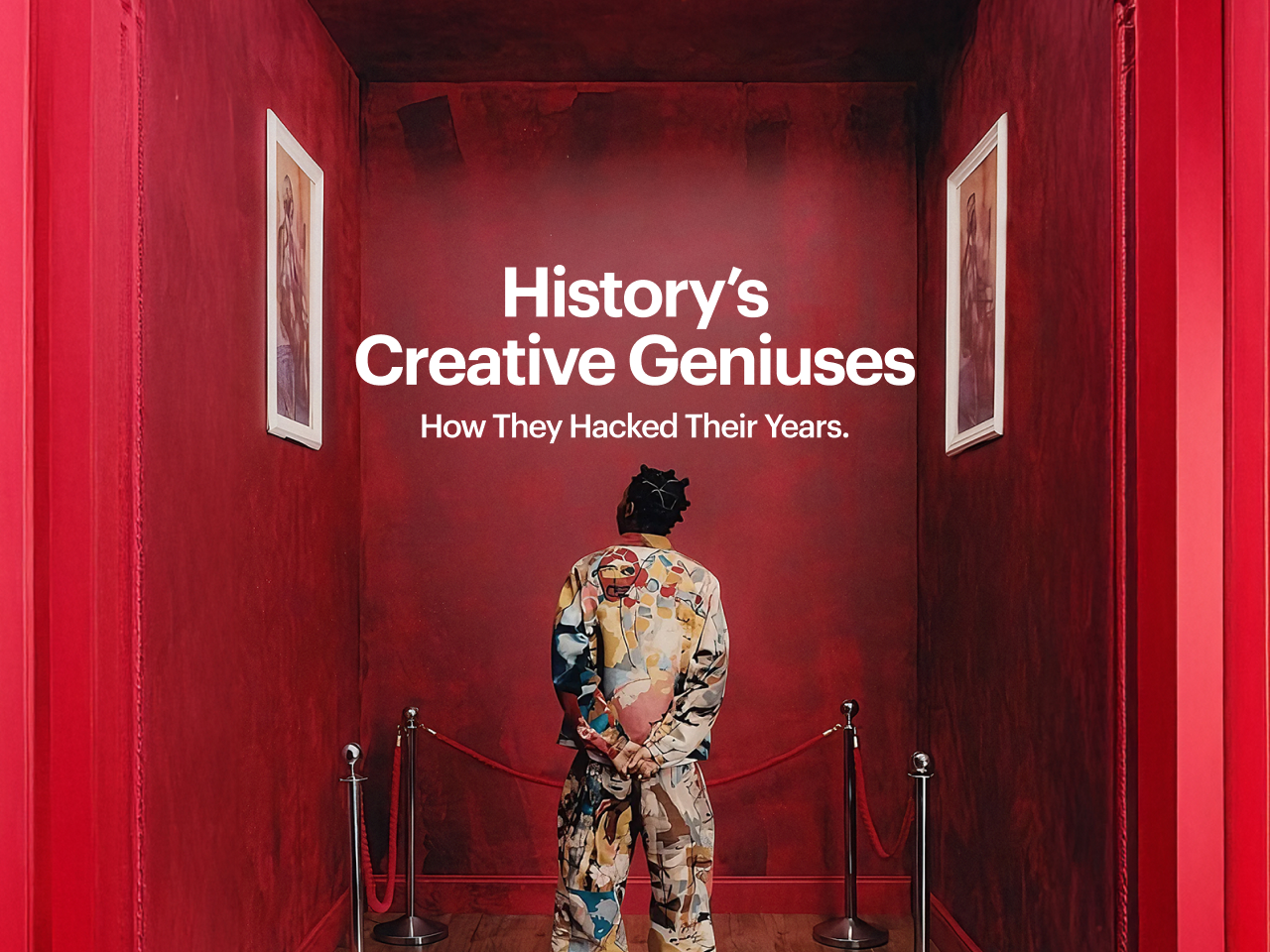
History’s Creative Geniuses

January 14, 2026
Spoiler: None of them bought a fancy planner
You know that feeling on January 1st when you’re convinced this will be the year you finish your novel, launch your side project, and somehow also learn Italian? By February, you’re just hoping to remember to water your plants. (We both know they’re kinda, sorta in trouble.)
History’s most productive creatives weren’t superhuman; they were just sneakier about how they structured their time. Let’s see how much we can steal from them.
The Maya Method: Rent a Room You Never Sleep In
Maya Angelou kept a hotel room she never stayed in. Every morning at 6:30 AM, she’d head to her rented room (stripped of everything except a bed, a Bible, a deck of cards, and a bottle of sherry) and write until 2 PM. Then she’d go home and edit.
Yes, she paid rent on a room purely to avoid the siren call of her own refrigerator. Legend behavior.
The hack: Separate your creation space from your living space. Your brain needs environmental triggers. Working from your couch is like trying to meditate at a Metallica concert. Find your “elsewhere.” A library corner, a specific coffee shop, that weird booth at the back of Panera, where the Wi-Fi is terrible but your brain unaccountably works.
Anywhere your neurons know: here, we make things. Here, we don’t watch TikTok for “research.”
Hemingway’s Trick: Stop Mid-Sentence
Hemingway had a rule that sounds psychotic until you try it: always stop writing when you know what happens next. Mid-sentence, even. Especially mid-sentence. Just walk away like a movie cliffhanger.
The hack: Never drain the tank. When you quit at the peak of your momentum, you’re giving tomorrow-you a running start instead of staring at a blank page, wondering if you’ve forgotten how to have ideas. This works for any creative work. Designers, stop mid-mockup. Musicians, leave one bridge unwritten. Strategists, save one insight for the morning. Future-you will thank present-you, and present-you gets to feel smugly prepared. Everybody wins except your anxiety about leaving things unfinished, but that guy’s a jerk anyway.
Beethoven’s Ritual: Count Your Coffee Beans
Beethoven was obsessive about his morning coffee. Exactly 60 beans, hand-counted every single morning, ground fresh. Was this necessary? Absolutely not. Did it work? Absolutely yes. Did his friends think he was unhinged? Almost certainly.
The hack: Weird rituals aren’t superstition; they’re switches. Your brain craves patterns like a golden retriever craves tennis balls. Beethoven’s bean-counting was a 10-minute meditation that signaled “we’re starting now.” Find your beans. Three stretches, two pages of journaling, one terrible dance move, sacrificing a small vegetable to the muse (mostly kidding). Whatever tells your brain to shift modes from “scroll Instagram” to “create something that might outlive you.”
Twyla Tharp’s Wake-Up: Automate the First Decision
Choreographer Twyla Tharp gets up at 5:30 AM and immediately gets in a cab to the gym. She says the most creative part of her routine is calling the cab. Everything else is automatic.
The hack: Willpower is finite, and breakfast depletes it. Automate your morning so you’re not wasting creative juice deciding whether to work out, what to eat, or if today is finally the day you become a smoothie person. (It’s not.) Wear the same clothes, eat the same breakfast, take the same first action. Save your decision-making energy for the work that actually matters. Steve Jobs wore the same outfit for a reason, and it wasn’t because he loved turtlenecks that much.
The Kafka Tragedy: Don’t Work a Soul-Crushing Day Job
Franz Kafka worked full-time at an insurance company and could only write late at night. He produced brilliant work and also died at 40, burned out and convinced he’d wasted his life. So, you know. Mixed results.
The hack (inverse): Protect your hours like your life depends on it, because it does. If you’re spending 40 to 60 hours a week on work that drains you, you’re not being responsible. You’re playing Russian roulette with your one weird, precious existence. This might mean living smaller, earning less, or disappointing people who want you to be “realistic.” (Translation: safely miserable like them.) Do it anyway. Nobody on their deathbed wishes they’d spent more time in meetings about meetings.
Morrison’s 5 AM Club (But Make It Honest)
Before Morrison became Toni Morrison, she was a single mom working as an editor. She woke at 4 or 5 AM to write before her kids woke up. Not because she was naturally a morning person (nobody is, or are they?), but because it was the only time that was actually hers.
The hack: Stop waiting for perfect conditions. They’re not coming. The muse doesn’t care about your sleep schedule or your convenience or that you read an article about circadian rhythms once. Find the margins. Early morning, lunch breaks, the weird hour after kids sleep when you’re too wired to rest but too tired to do anything “productive.” String together the stolen moments. Empires have been built in the cracks. So have novels, albums, and movements.
Picasso’s Principle: Work on Multiple Things
Picasso typically had several canvases going simultaneously. When he got stuck on one, he’d rotate to another. His Blue Period? He was also painting something completely different on the side. The man had a better project pipeline than most agencies.
The hack: Creative block on project A often dissolves when you’re focused on project B. Your brain is a sneaky little background processor. Keep multiple projects alive. Not to multitask (that’s a lie Silicon Valley told you), but to give your subconscious permission to work while you’re consciously doing something else. When you’re stuck on your screenplay, work on your zine. When the zine feels stale, return to the screenplay. Watch your brain suddenly have opinions about the thing you weren’t touching.
The Joan Didion Discipline: Track Everything
Didion kept meticulous notes about when she wrote, how long, and how it felt. Not for publication. For data. She treated her creative process like a scientist treats experiments, which is probably why her sentences can perform surgery on your emotions.
The hack: You can’t improve what you don’t measure. Track your patterns. When are you sharpest? (Not when you think.) How long can you actually sustain deep work before your brain turns to oatmeal? What conditions make you produce garbage? Most creatives have strong opinions about their process and zero data to back it up. You’re smarter than that. Build a dataset on yourself. Become your own case study. Let the patterns reveal themselves, then exploit them ruthlessly.
The Real Productivity Hack Nobody Wants to Hear
What all these people have in common: they showed up. Regularly. Boringly. Repeatedly. They didn’t wait for inspiration to strike like some kind of creative lightning bolt. They built structures that made creation inevitable.
You don’t need a hotel room or a cab ritual or exactly 60 coffee beans. (Though if counting beans brings you joy, count away, you magnificent weirdo.) You need to stop romanticizing the work and start protecting the time.
You need to build a year where your creative practice isn’t something you squeeze in around your “real life.” It is your real life, and everything else is just funding and logistics.
The most productive year of your life won’t come from a new app, a better system, or that $47 course promising to unlock your potential. It’ll come from deciding that your creative work matters enough to architect your entire existence around it, and then doing the deeply unsexy work of showing up for it. Day after day after day. Even when it’s boring. Especially when it’s boring.
Productivity is a practice. It’s choosing your work over scrolling, over Netflix, over the very reasonable voice in your head that says you’ve earned a break. (You haven’t. Not yet. You literally just started.)
Now close this tab and go make something. The clock’s already running.