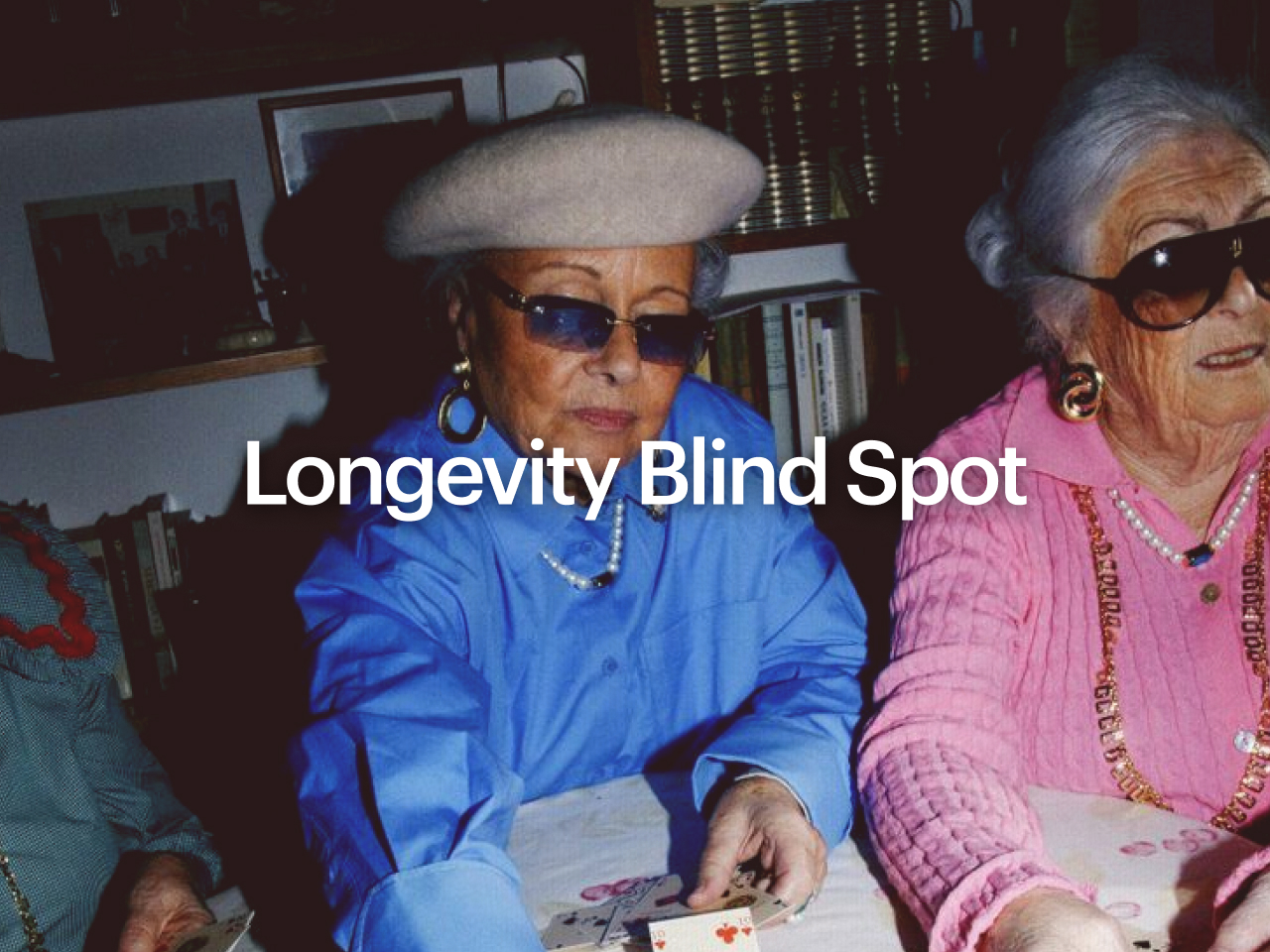
Longevity Blind Spot

July 22, 2026
The default face of almost every campaign launch, or "target audience" slide is somewhere between 22 and 34, dewy and unbothered, as if nobody buys anything after their metabolism slows down. It is the most expensive collective blind spot in the creative business, and this year the numbers finally got too big to keep squinting past.
Start with what older consumers spend right now, today, while very much alive. AARP's 2026 Longevity Economy report found that Americans aged 50 and up generated $12.5 trillion in annual economic activity, and that if this group were its own country, it would be the world's third-largest economy, behind only the United States and China. Harvard Business School put a finer point on it in May, when professor Elie Ofek published research describing older consumers as a $7-trillion opportunity that marketers keep chasing, right past. People over 50 control the majority of household wealth in developed nations.
And yet the creative industry keeps designing for the demographic with the least money and the most student debt.
The older generation is not just the biggest spender in the room. It is about to become the biggest giver in history. Cerulli Associates estimates that roughly $124 trillion will change hands in the United States alone through 2048, up from an earlier projection of 84 trillion, once you account for how much stocks and real estate have run.
This is the Great Wealth Transfer, the largest intergenerational handoff of money ever recorded, moving at something like a trillion dollars a year and accelerating. On January 1 of this year, the leading edge of the Baby Boom turned 80. The trickle is becoming a flood.
The wealth is landing on both ends of the pipe at once. Older consumers hold the spending power now, and their children and grandchildren are about to inherit a sum roughly four times the annual output of the entire American economy. A brand that earns trust with a 68-year-old today is not making one sale. It is an audition for a relationship with the person who signs the estate, often with the heir standing beside them. Cerulli found that 60 percent of millennials plan to switch financial advisors after they inherit, which tells you how loose these loyalties actually are and how much is up for grabs.
The money is in motion, and most of our industry is filming an entirely different movie.
So why the blind spot? Part of it is lazy shorthand, the belief that older people are frugal, set in their ways, and off in some analog wilderness. The data laughs at this. Nearly 90 percent of adults between 50 and 70 own a smartphone. During the pandemic, telehealth use among the over-55 crowd jumped more than 350 percent. These are not laggards; they are frequently early adopters and premium buyers who also shape the major purchases of everyone younger in the family.
The other part of the blind spot is that we have been solving the wrong design problem. For decades, marketing to age meant the language of correction, the anti-aging serum, the defying, the repairing, the not-so-subtle message that getting older is a defect to be patched.
The brands getting it right have stopped apologizing for age, and here is the useful bit for your next project. Ofek's research notes that most older adults feel 15 to 20 percent younger than their actual age,
so the winning move is to speak to how people see themselves rather than to a number on a form.
When L'Oréal Paris built its Age Perfect line around Helen Mirren, then 69, it did not frame her as a problem being managed. It made her the standard and reportedly pulled in tens of thousands of new buyers doing it. When BMW noticed its customers aging, it did not launch a "senior" model. It added larger, clearer controls that require less dexterity and called them what they were, a better design for every driver.
That is the whole trick. Good longevity design does not condescend.
It just works for both the 30-year-old and the 70-year-old, which is what great design was supposed to do all along.
We have shared in Ding! newsletter that identity is the one thing that never becomes a commodity, that the world needs the specific and irreplaceable version of you. The same holds for who you design for. The industry has spent years fighting over the attention of a generation that is broke, distracted, and skeptical of ads, while the wealthiest and most loyal customers in the market sat in plain sight, wallets open, wondering why nobody was talking to them.
So the question for your studio, your brand, your next pitch is not whether to chase youth or age. It is simpler and more uncomfortable than that. When the largest pile of money in human history starts moving, will your work be in the room, or will you still be filming the metabolism ad?