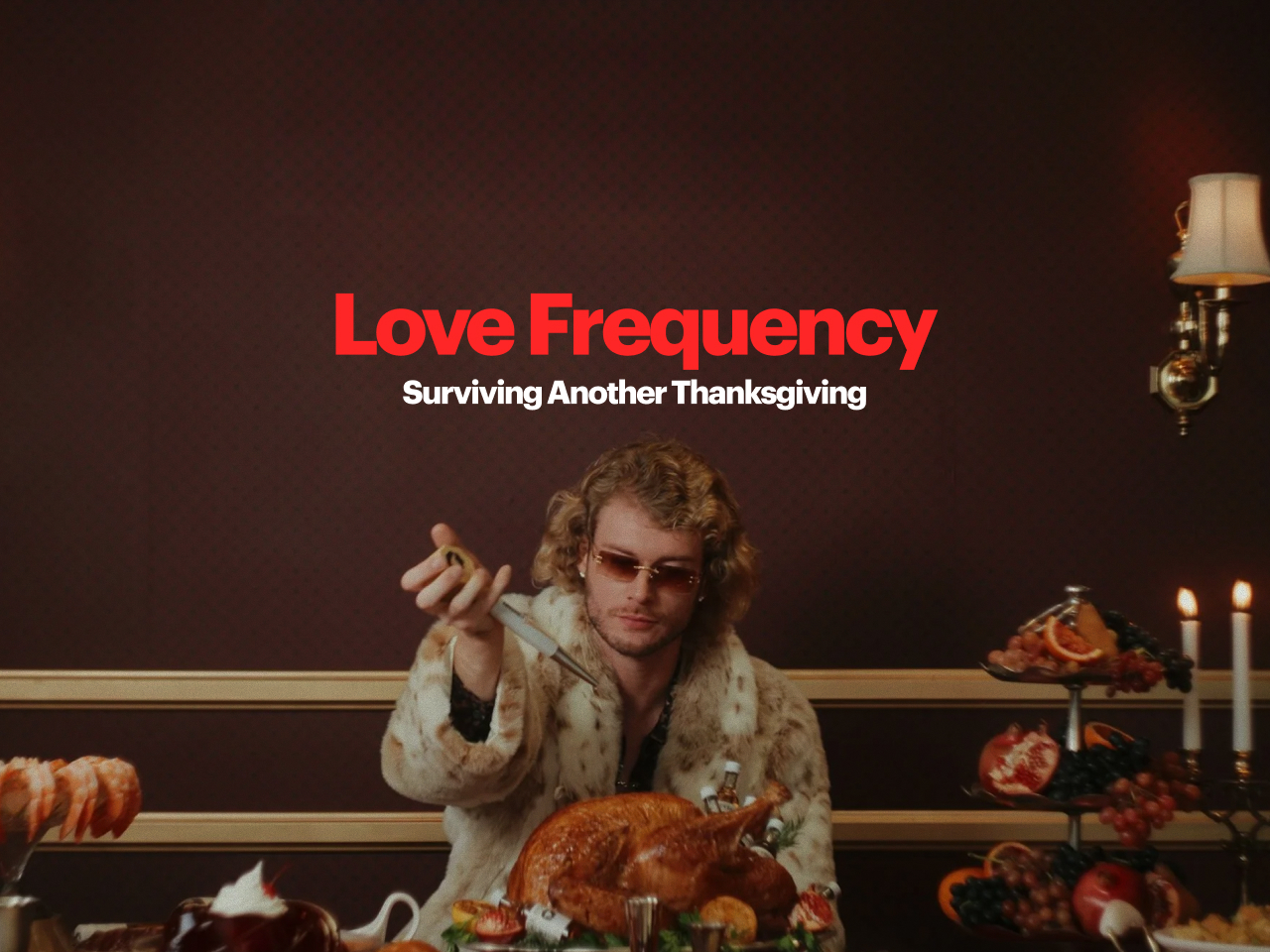
Love Frequency

December 3, 2025
You survived Thanksgiving. Barely!
Smiled through Uncle Jerry's monologue about border policy while passing the gravy. Nodded at Aunt Susan's veiled critique of your career choices. Watched your cousin explain Bitcoin for the forty-seventh time to your grandparents, who still love to write their checks.
This is just what families do. We love each other fiercely and occasionally want to weaponize the cranberry sauce (ouch!).
Let's share something weird we stumbled into: there might be a way to take the edge off next time. We're not suggesting therapy, though God knows we could all use it, but music. Specifically, music tuned to 528 Hz. They call it the "love frequency," which sounds like something a guy selling crystals in Sedona would tell you, except there's actual research to back it up.
Wait, Frequency Does What Now?
528 Hz is part of this ancient scale called Solfeggio frequencies. The same tones Gregorian monks chanted back when Netflix was several centuries and a technological revolution away. The note sits at "Mi" in the scale, from the Latin mi-ra gestorum, meaning miracle. Which feels like overselling it until you look at what scientists have actually found.
A team in Japan ran a study in 2018 in which participants listened to 528 Hz music for just five minutes. Their stress levels dropped. Not "I feel slightly better, but a measurable cortisol reduction in their bloodstreams. Another study found it increased oxytocin, the hormone that makes you feel calm and connected, instead of like you want to flip the dinner table.
They tested this on rats, too. Science is weird. Rats exposed to 528 Hz showed way less anxiety and even had higher testosterone in their brains. One study found that the frequency increased cell lifespan by about 20% and helped cells recover from alcohol toxicity, which (given how much wine it takes to survive certain family members) feels appropriate.
There's also this claim that Gregorian chants at 528 Hz increased UV light absorption in DNA by 5 to 9 percent. We don't fully understand what that means, but it sounds impressive in a vaguely biological way.
Songs You Already Know
It gets even more interesting from here. John Lennon's "Imagine"? Recorded in 528 Hz. According to Lunartunar, who tracks this stuff anyway. So one of the most emotionally affecting peace anthems ever made (the song that makes stadium crowds sway with their lighters up) vibrates at the love frequency.
That's not the only one. "Let It Be" and "Yesterday" by The Beatles. Whitney Houston's "I Will Always Love You." Celine Dion's "My Heart Will Go On." John Legend's "All of Me." You know these songs. You've cried to them, probably. They're the ones that hit different, making you feel something or look at someone differently.
Some musicians tune deliberately to this frequency. Paul McCartney reportedly did so in his later years. When you tune A to 444 Hz instead of the standard 440 Hz, C lands right on 528 Hz. Dr. Leonard Horowitz (who wrote: The Book of 528: Prosperity Key of Love) has been championing this for years.
It could be a coincidence, or maybe there's something to the idea that certain frequencies resonate with us in ways we don't yet fully understand. The heart chakra stuff we'll leave to people more spiritually inclined than us, but the physiology is harder to dismiss. Your nervous system responds to sound. That's not woo; that's biology.
The Experiment You Should Run
Here's what we're suggesting: next time your family gathers (Christmas, maybe), make a playlist. Don't announce it or explain it. Just queue up songs in 528 Hz and let them fill the spaces between conversations.
Will it prevent your brother-in-law from derailing dinner with his thoughts on vaccine mandates? No. Will it stop your mom from asking why you're still single? Absolutely not. But it might soften things just enough. It might make people a fraction more patient and keep someone from saying the thing that ruins dessert.
Think of it like lighting. You dim the lights at dinner because harsh fluorescents kill the mood. Why not do the same thing with sound?
Worst case scenario: you've made a playlist of genuinely beautiful music, and nothing changes. Best case: you've accidentally hacked everyone's nervous system into behaving like reasonable humans for three consecutive hours.
The turkey, having already sacrificed enough, would appreciate the effort.
Does This Actually Work?
We’re biased, so we’ll say we don't know, definitively! The research is early and small-scale. Five minutes of stress reduction in a lab doesn't necessarily translate to surviving your family's greatest hits of dysfunction. And frequency science is one of those areas where legitimate research coexists uncomfortably with people selling $400 tuning forks that "align your energy field."
We constantly manipulate our environments, choosing paint colors based on how they make us feel. We burn candles. Rearrange furniture, play certain music when we need to focus, relax, or feel something. Why not extend that to frequencies?
Maybe 528 Hz works because of some deep biological resonance we're only beginning to understand, or it works because you've curated a playlist of emotionally resonant songs that people associate with love and connection, and that's enough. Maybe placebo effects are real effects, and we should stop being so precious about the mechanism.
We just know that navigating family holidays requires every advantage you can scrape together. And if science says a certain frequency might calm people down (even a little, even temporarily), We're willing to try it.
One Last Thing
Families are complicated. That's not a bug; it's the whole deal. The same people who drive you insane are the ones who showed up when things got dark. That dinner table where someone always says something unforgivable is also where you laughed until you couldn't breathe.
528 Hz won't fix the fundamental weirdness of loving people you sometimes can't stand. But it might give everyone's nervous system a fighting chance. It might create just enough space for grace.
And if nothing else, you'll have discovered something interesting about music and frequency and the strange ways sound moves through us. You'll have "Imagine" and "Let It Be" queued up for the moment when someone needs to remember why we keep doing this.
Because we keep showing up. We keep passing the potatoes. We keep trying.
Maybe 528 Hz can help us do it with a little more love.