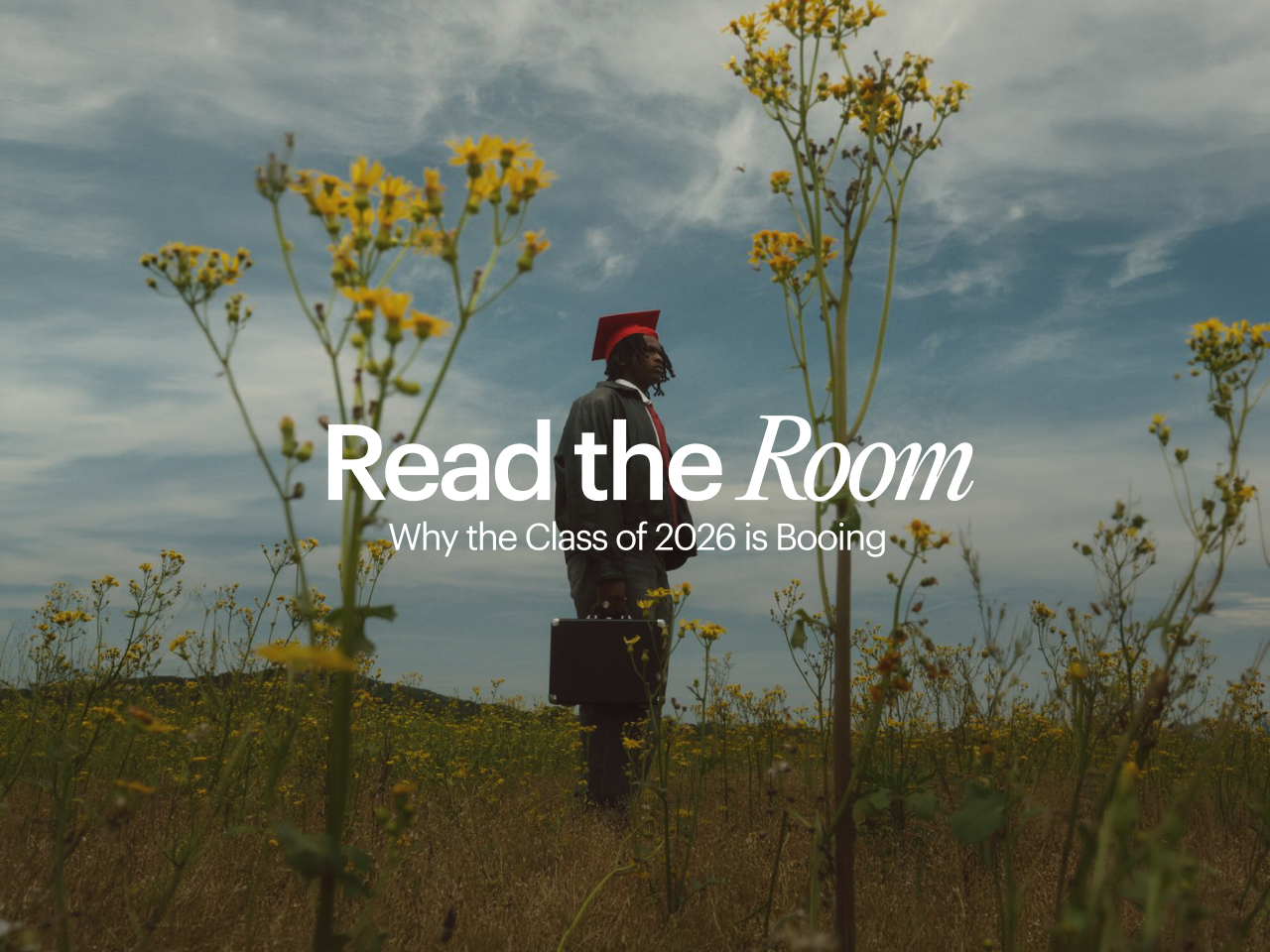
Read The Room

June 3, 2026
On May 8, 2026 a real estate executive named Gloria Caulfield stood in front of the arts and humanities graduates at the University of Central Florida and called the rise of artificial intelligence "the next industrial revolution." She got about half a sentence in before the boos rolled over her.
"Okay, I struck a chord," she said, genuinely surprised. "May I finish?"
The next day, ninety minutes up the map at Middle Tennessee State, the music executive Scott Borchetta told graduating students that
"AI is rewriting production as we sit here."
Same reaction. Except Borchetta, who runs Big Machine Records and discovered Taylor Swift, decided to argue with the room. "Deal with it," he said. "It's a tool." Then, as the noise grew, "you can hear me now or pay me later." For the finale, he informed a class of students whose parents had just paid for four years of education that some of what they learned in their first year was "already obsolete." The college that named an entire school after him watched its graduates boo him off the rhythm of his own speech.
A week after that, Eric Schmidt, who ran Google for a decade, faced the same wall at the University of Arizona. Arizona is the messy case, since students had organized against him for weeks over an unrelated lawsuit, and the booing started before he even reached AI. But it got loudest every time he turned to the machines. He compared this moment to the arrival of the personal computer and told the graduates that the future was theirs to shape, which somehow came across as the most irritating thing he could have said.
It would be easy to file all this under kids these days, or under the usual sport of jeering whichever CEO drew the short straw at graduation. That reading misses what is actually happening, and it misses it in a way creative leaders cannot afford to.
These students are not booing technology; they are booing a posture. Every one of these speakers walked onstage with a version of the same message, delivered with the breezy confidence of someone who is not personally exposed to the downside: the future runs on AI; it is inevitable; it is exciting; now go out there and make it work for you. To a twenty-two-year-old staring at the actual job market, that message does not sound like inspiration.
It sounds like a man who already got his seat telling everyone else the ride is full.
And the market backs the students' instincts, not the speakers'. Entry-level job postings in the US are down roughly a third since early 2023, with AI absorbing the routine work that used to be a junior's entire reason for being on the payroll. Unemployment for recent graduates has climbed to levels the country has not seen in years outside the pandemic, running well above the rate for workers as a whole, and a large share of those who do find work are underemployed. The grunt tasks that were never glamorous, the junior analyst pulling the deck together, the assistant doing the first pass, the coordinator chasing the details, are exactly the tasks getting automated first. Employers are saying it out loud:
If the machine handles entry-level work, then new hires have to arrive already operating above entry level.
Nobody has explained how you are supposed to get good at a level you are never allowed to occupy.
We have been here before in these pages. We wrote about the Junior Erasure, the slow disappearance of the entry-level creative role, and what it costs the industry to stop hiring the people it depends on to replace itself. The argument then was that a junior job was never just a line on an org chart. It was the transfer mechanism, the way fifteen years of a senior creative's hard-won judgment moves into the next person through proximity, through bad first drafts getting fixed, through being in the room when something goes sideways.
Remove the room, and you remove the education.
The booing is that same crisis, except now it has a voice and a face, and the face belongs to a generation that figured out the math faster than the executives flying in to congratulate them. They sat through the speeches. They understood the subtext. The subtext was that the ladder they spent four years and a small mortgage preparing to climb is being pulled up rung by rung, and the people pulling it would like a round of applause for their candor.
Honestly, what makes this a creative-industry story, not just a labor one? Borchetta, to be fair to him, said one true thing buried under the smugness, which is that human creativity matters more than the platform. He is right. The trouble is that human creativity does not appear by magic in a twenty-seven-old. It is built slowly out of a thousand small failures that someone more experienced was paying close enough attention to catch.
An industry that automates away the conditions for that growth, and then demands fully formed talent it never invested in producing, is eating its own future and calling it efficiency. The boos are the sound of young people noticing.
So pay attention to them. Not in the soft, performative way where a company posts about supporting the next generation and then opens zero junior roles. If you lead a studio or a team, the most useful thing you can do this year is build back a way in. A real apprenticeship. A junior seat protected on purpose, even when the spreadsheet says a senior with better tools is more efficient for the next five years. Especially then. Because the alternative is a profession full of people who are excellent at directing the machine and have no idea why the work is supposed to be good, because no one was ever there to teach them.
The graduates in those crowds are not naive about AI. Most of them use it daily. They are not asking the world to stop the technology. They are asking, with the only instrument available to them on graduation day, for someone with power to acknowledge that the on-ramp is closing and that this is a problem worth solving rather than a fact to be congratulated on. The speakers heard noise. What the room was actually saying was: we are ready to work, and you have not left us anywhere to start.
The people who lead well over the next decade will be the ones who heard that correctly. Not "deal with it." Closer to:
We built this gap, so we are going to build you a way across it.
Peace.