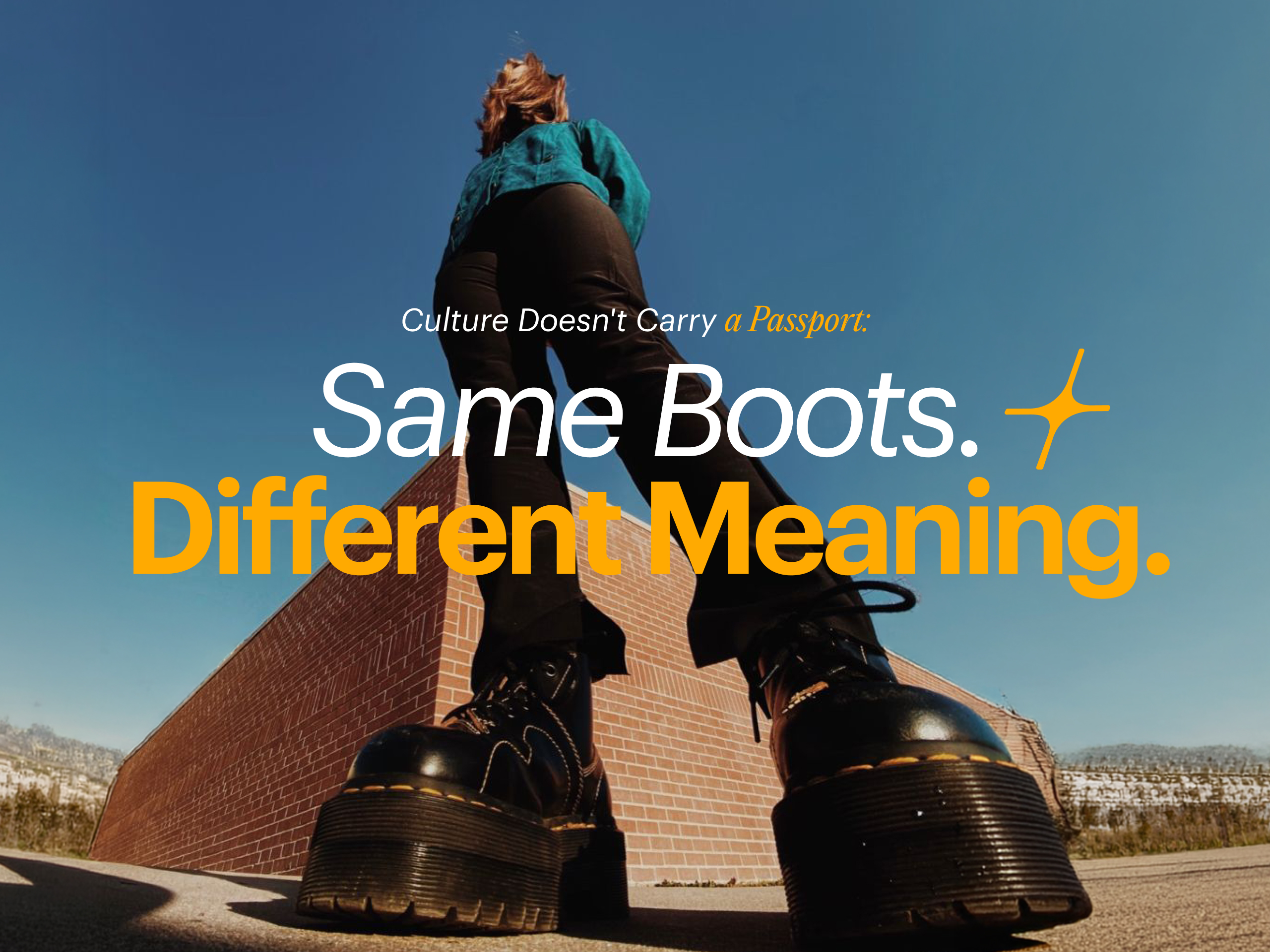
Same Boots. Different Meaning

October 14, 2026
Buy a pair of Dr. Martens in Manchester, and you're buying into punk, school-uniform rebellion, and three generations of British kids stomping around in yellow stitching. Buy the same pair in Ohio and, statistically speaking, you've bought some boots.
That's a slightly cheeky reading of the new Gen Z Brand Radar from research consultancy Basis Global, but only slightly. Dr. Martens ranks first in the UK and appears in all six of the ways the study tracks Gen Z talking about brands. In the U.S., it ranks 40th and appears in only one. It's the same product at the same price with the same stitching, and it lives a completely different life on each side of the Atlantic.
When Basis compared each market's top five, only two brands made both lists. The UK's five are Dr. Martens, Lush, Glossier, BrewDog and Adidas. America's are Nike, Apple, Adidas, Glossier and Patagonia.
These two countries share a language, most of their television and nearly all of their memes. If young people in London and Los Angeles can't agree on what matters, the assumption that a brand means the same thing in Jakarta, Nairobi and São Paulo looks awfully optimistic.
If London and LA can't agree, nobody can.
Meanwhile, going global has never been easier. At its Made on YouTube event a few weeks ago, YouTube said more than 40% of live watch time comes from viewers outside a creator's home country, and announced a pilot of live auto-dubbing starting in early 2027, which translates a creator's speech in real time so viewers can listen in their own language. Distribution is becoming borderless at the same moment meaning is getting more local. Those two trends will collide in many marketing plans next year.
For most of the last century, "global brand" meant sameness. You made one campaign, usually in New York or London, dubbed and subtitled it for everywhere else, and called the result consistency. It was expensive, which is partly why only the giants did it. AI is about to make that playbook almost free. Brands of every size will be able to push one message into forty languages by Friday afternoon. Once everyone can do it, doing it will earn you roughly nothing.
Translation is about to be free. Meaning is still expensive.
The Radar hints at what works instead. Only 5% of the top 80 U.S. brands show up across all six conversation types, which suggests most brands win in specific contexts rather than owning the whole relationship. Even the global top ten is a patchwork. Uniqlo, a Japanese basics retailer, sits fifth, and The Ordinary, a budget skincare line, sits sixth, alongside Nike and Apple. None of them got there by shouting the same line everywhere. People in different places picked them up for their own reasons and made them fit.
We should be honest about the limits. The Radar covers only the U.S. and the UK, and it's built on social listening, drawing on more than 50 million signals across social, search, and digital behavior in 2025, so it measures what people discuss, which isn't the same as what they buy. If anything, that makes the finding conservative. Two English-speaking markets with a shared pop culture are the mildest version of this problem you'll ever encounter. The distance between Seoul and Lima is a lot bigger than the distance between Leeds and Boston.
For creative leaders, the practical move is almost embarrassingly small. Stop writing "global" at the top of the brief. It's the least useful word in the document. Write where instead. Describe who is standing on which corner, what they already believe about you, and what your category means on their street. A global brand today works more like a federation.
It holds one set of values and a lot of local fluency about how to express them, and most organizations have only budgeted for the first part.
For emerging creatives building careers far from the big design capitals, we suspect you've felt pressure to sand the local off your work so it reads as international. We'd push back, firmly. Your specificity could be exactly what you export. The designer who really understands how Lagos or Manila or Medellín talks to itself is about to be worth a great deal to brands whose beautifully dubbed campaign just landed with a thud.
We've started using a simple test on our own ideas: move the idea 500 miles and see what happens. If it arrives completely intact, be a little suspicious, because it may be generic. If it falls apart, ask whether it was built for the right place in the first place. Neither answer is automatically bad. The problem is not knowing which one you've got.
Dr. Martens didn't change a stitch between Manchester and Ohio. The boots were never really the point. The point was everything Manchester had put into them over fifty years, and no shipping container can carry that.