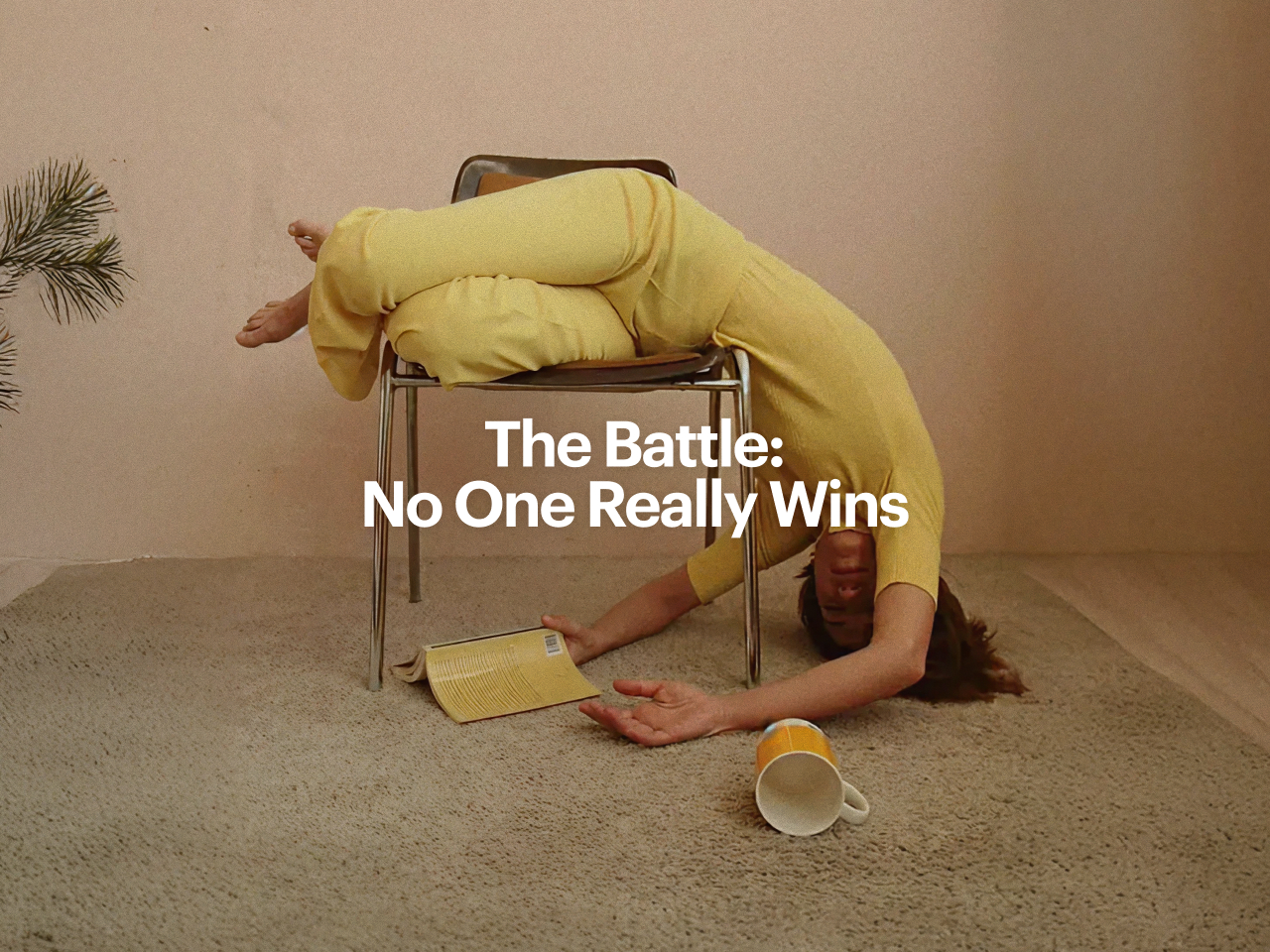
The Battle
February 18, 2026
I came across The War of Art by Steven Pressfield recently, and it felt less like discovering something new and more like someone finally naming the thing that's been following most creatives around for years. You know the feeling. That moment when you pause mid-page and think, "Oh. So there's a word for this particular flavor of self-sabotage."
Pressfield identifies the quiet adversary most creatives wrestle with daily: Resistance.
Not the convenient kind or the external obstacles we can elegantly blame at dinner parties. He's not talking about difficult clients, impossible deadlines, or the fact that your budget wouldn't cover a decent lunch. He's describing the internal friction that materializes when you attempt work that matters to you.
Resistance doesn't show up when you're reorganizing your desk for the third time this week or adjusting that kerning by half a pixel. It appears when you begin something vulnerable. When you attempt an idea that feels slightly beyond your current identity. When you sense that finishing this piece, launching this concept, or sharing this perspective might actually change how you're seen.
The truth is, the strength of Resistance is directly proportional to the importance of the work.
Inconsequential task? Resistance takes the day off. Work with potential to move you forward? Resistance becomes remarkably articulate.
It doesn't shout, but reasons with impeccable logic (If I might add).
It suggests you need more preparation. (You probably do, but that's not the point.) It reminds you that timing could be better. (When has timing ever been perfect?) It encourages you to improve your skills before exposing yourself. (Translation: indefinitely.)
It sounds responsible, mature and strategic. Like the voice of wisdom itself.
The Myth of Arrival
Emerging creatives often assume this tension signals a lack of readiness. They interpret doubt as disqualification. They imagine seasoned creatives have outgrown this internal negotiation, that somewhere around project fifty or follower milestone X, confidence finally replaces hesitation. It doesn't.
What changes over time isn't the presence of Resistance, but your familiarity with it. You begin to recognize its greatest hits. You notice how it surfaces right before you commit to something meaningful. You learn that the anxiety preceding important work isn't a red light, but often a neon sign pointing toward exactly what you should be doing.
Pressfield offers a distinction that's both simple and slightly uncomfortable: the difference between the amateur and the professional. The amateur waits for the right mood, the right stretch of uninterrupted time, the right surge of confidence. Basically, they're waiting for conditions that exist roughly as often as a meeting that ends early.
The professional works under imperfect conditions, understanding that inspiration is often a by product of motion rather than a prerequisite for it.
Inspiration, it turns out, is terrible at keeping appointments but excellent at showing up uninvited once you've already started.
The Modern Disguises
The more I reflected on this, the more I realized how easily Resistance disguises itself in modern creative life. It hides in endless research tabs. (Surely you need to read just one more article.) It thrives in comparison. (They're younger, better funded, and their grid is immaculate.) It flourishes in overthinking. (This needs to be reconceptualized from first principles.)
We tell ourselves we're refining, curating, optimizing. Sometimes we are, but often we're just avoiding with extra steps.
And yet, the presence of Resistance carries a strange comfort. It means you care, means the work has stakes. Indifference rarely generates internal conflict; only meaningful pursuits come with this particular brand of psychological warfare.
For emerging creatives, this may be the most important reminder: the discomfort doesn't disappear with experience. It evolves. Early in your career, you fear not being good enough. Later, you fear not sustaining momentum. Eventually, you fear becoming irrelevant.
The battle isn't against the industry, the algorithm, or the competition. It's against the part of yourself that prefers safety over growth.
The Unremarkable Truth
The takeaway isn't dramatic, just that there's no secret formula, no hidden shortcut, or productivity hack that will finally make this easy.
You sit down. You begin. You continue.
Over time, that ordinary ritual compounds. It builds confidence not from affirmation, but from evidence. You start to trust yourself, not because fear vanished, but because you have repeatedly acted in its presence.
You won't permanently silence Resistance. The moment the work grows, so will it. That's not a flaw in your character. It's a reflection of the value of what you're attempting.
So if you find yourself circling an idea, hesitating before publishing, or questioning whether you belong in the room, consider the possibility that you're standing at the edge of something significant. The friction you feel may not be a warning to stop, but an invitation to proceed.
Creativity is a daily decision to confront yourself and choose growth over comfort.
Seat in chair. Again tomorrow.
Peace.