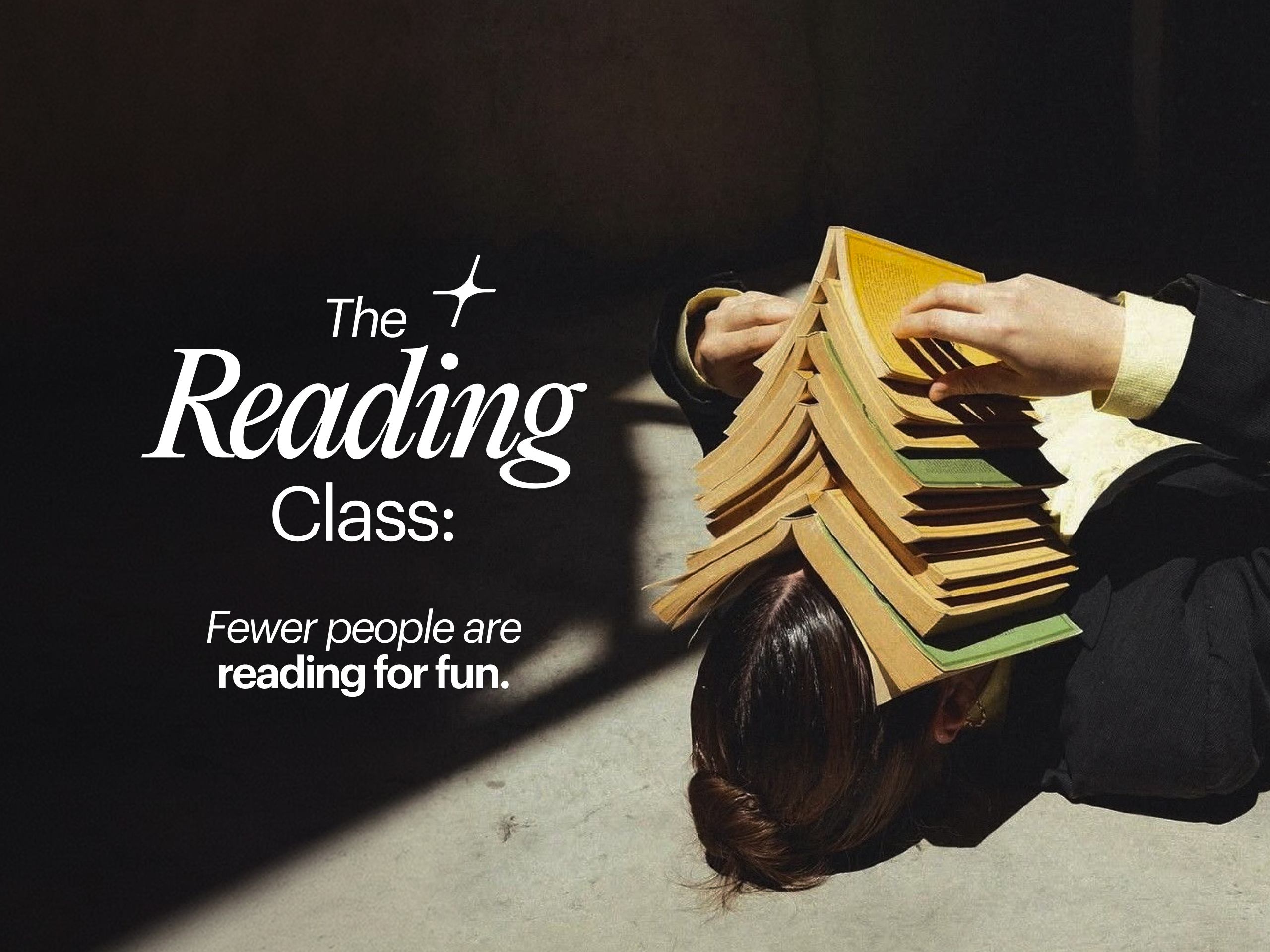
The Reading Class

November 11, 2026
Somewhere in your organization, there's a brief nobody finished.
It runs to eleven pages. One person read the first two, another skimmed the summary, and a third asked a chatbot to summarize the summary. Then everyone went off and made work that answered a slightly different question from the one the client asked. We've all been in that meeting, usually on the wrong side of the table.
The numbers behind that brief are getting hard to ignore. Last year, researchers at University College London and the University of Florida published an analysis of more than 236,000 Americans who filled in the government's American Time Use Survey between 2003 and 2023.
In 2004, 28 percent of them read for pleasure on a given day. By 2023 it was 16 percent, a fall of roughly 40 percent, or about 3 percent a year. The study counted books, magazines, newspapers and audiobooks alike, so you can't blame the decline of print.
The annual figures point the same way. The National Endowment for the Arts found that 48.5 percent of American adults read at least one book for pleasure in the year to July 2022, down from 54.6 percent a decade earlier.
Then comes the detail that should interest anyone who manages creative people. Among Americans who still read for pleasure, time spent reading went up, from an hour and 23 minutes a day to an hour and 37. The researchers suggested this may be a polarization, with some people reading more while many stop altogether.
Fewer readers, reading more. That split runs straight through creative teams.
Education researchers have a name for this pattern. In 1986, Keith Stanovich described "Matthew effects" in reading, borrowing the Gospel line about the rich getting richer. Children who read well read more, learn more words and so read better still.
Children who struggle read less and fall further behind, and the gap widens with time. Stanovich was writing about schoolchildren. We'd argue the same arithmetic runs through working life, and creative work is where it bites hardest.
Think about what reading does in an organization. It's how research turns into strategy, how references stop being a mood board and start being ideas, and how a designer learns a category well enough to break its rules on purpose.
The person who read the whole brief, the interview transcripts and the annual report asks better questions at the kickoff. Those questions compound. Six months later, the gap between that person and the colleague working from summaries looks like talent. A fair amount of it is pages.
Designers know better than anyone how little people read, because we've spent years designing around it. Jakob Nielsen's research found that on an average web page, users have time to read at most 28 percent of the words, and 20 percent is more likely.
Whole disciplines grew out of that fact: scannable layouts, punchy subheads, the F-shaped reading pattern. All sensible.
The trouble starts when the habits we design for become the habits we work by.
Our archive has circled this before, in pieces on the war on focus and on feeding your creative diet with stranger ingredients. What's changed is the shape of the problem. A decade ago you could treat reading as a personal virtue, somewhere between flossing and going to bed early. When one in six Americans reads for pleasure on a given day, it starts to look like a competitive advantage, and an unevenly shared one.
The UCL and Florida team found steeper drops among people with lower incomes and less education, and in rural areas. Time and access decide who gets into the reading class, and organizations that care about who they hire should care about that too.
There's some good news from the UK. The National Literacy Trust surveyed more than 125,000 children and young people between January and March this year, the opening months of the country's National Year of Reading. After hitting a 20-year low in 2025, the share of 8 to 18 year olds who say they enjoy reading rose to 36.1 percent, from 32.7 percent. Daily reading ticked up too.
Nobody can yet say the campaign caused it. But a decline everyone had filed under inevitable turned around within a year, which suggests habits respond when someone makes reading social and visible.
That's the lesson we'd carry into any organization. Reading survives when it's treated as part of the work. Put reading time on the timesheet and mean it. Write shorter briefs with longer appendices, then ask at the kickoff who opened the appendix.
Start a reading group, even a tiny one; the American Academy of Arts and Sciences notes that participation in book clubs and reading groups grew while book reading overall fell, so people clearly still like reading together. And when someone in a meeting quotes the source instead of the summary, say you noticed.
For emerging creatives, this may be the cheapest edge on offer. A library card is free. Read the whole thing: the original study, the long interview, the dull annual report.
Reading might be the last unfair advantage that's legal, cheap and open on Saturdays.