The Trust Collapse

July 8, 2026
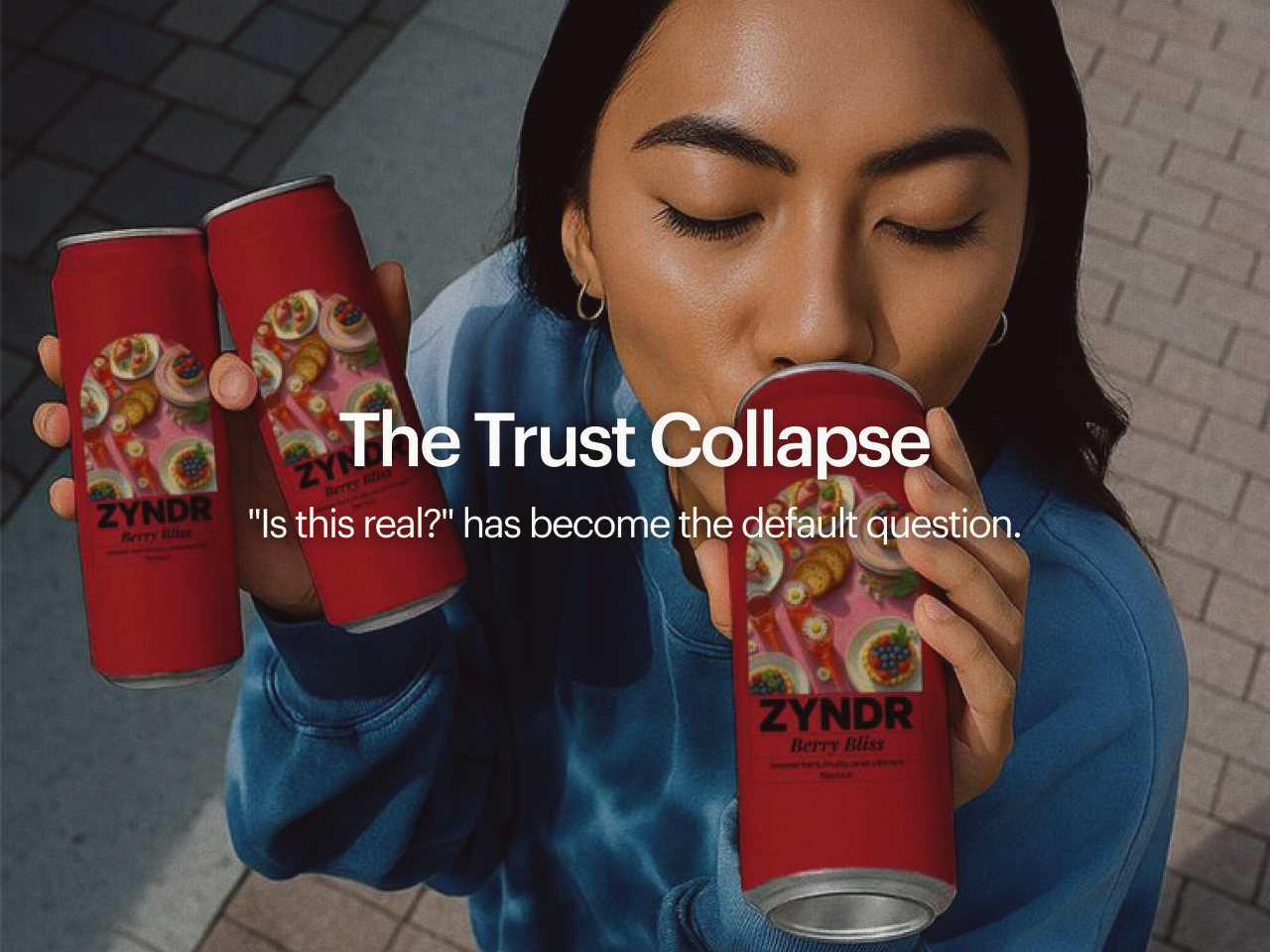
A few weeks ago, a law took effect in New York that would have read like science fiction a decade ago. As of June 9, any advertiser running an ad to a New York audience that features a synthetic performer, a fabricated human who looks like a person but is no one at all, has to say so, in a conspicuous disclosure, or face a fine. A thousand dollars for the first offense, five thousand for each one after. The state attorney general enforces it. New York is first, but California's provenance rules land in August, and a row of other states are drafting their own.
Think about the strangeness of that. We now have a law on the books whose sole purpose is to require companies to admit when the human in their ad is not human, because we have arrived at a place where you genuinely cannot tell anymore, and somebody decided that not being able to tell was a problem worth legislating.
That law is a symptom of a bigger disease, and it's the thing every brand and every designer is now working inside whether they've accepted it or not. The shared baseline of belief that all communication used to stand on, the assumption that the person in the photo existed, that the testimonial came from a real customer, that the thing you're looking at was made by someone, has thinned out to almost nothing.
Around three in five people now say they doubt whether the things they see online are real at all. The default posture of the audience has flipped from "probably true unless something's off" to "probably fake unless proven otherwise," and that flip changes the ground under everyone whose job is to make people believe something.
For most of the creative profession's history, trust was the air. You didn't have to manufacture the assumption that your creation depicted real things, because that assumption came free. A photo meant a camera pointed at something that happened. A face meant a person. The work was about what you did on top of that foundation, the angle, the story, the feeling.
Nobody had to spend a budget line convincing you the foundation was solid, because no one had reason to doubt it.
That free thing is gone, and it isn't coming back. When the audience assumes fabrication by default, the entire job reorganizes around a question that used to answer itself: how do we prove this is real before we even get to whether it's good? Proof of reality is now part of the brief. It wasn't, for a hundred years, and now it is.
The part that should interest you (if you’re reading this) and you make things for a living is. When something becomes scarce, the market starts paying for it, and the thing that just became scarce is verifiable human origin. You can watch the price forming in real time. "Human-made" is becoming the new "organic," a label that signals quality precisely because the cheaper, faster machine version is now everywhere. Publications have started stamping articles as human-written. Music libraries sell human-composed tracks as a premium tier above the generated stuff. On the craft marketplaces, the handmade markup is widening, not shrinking, as AI products flood in beside it. And brands have noticed. Earlier this year Almond Breeze ran a campaign with the Jonas Brothers built entirely around rejecting AI concepts on camera, titled, with no subtlety at all, "No AI Needed." Aerie, Dove, and others have planted similar flags. The pitch underneath all of it is the same:
A person did this, on purpose, and that is now worth paying extra for.
We'd offer one caution, because the move is so tempting, it's already curdling in places. A label is not a substitute for the thing it claims. "Human-made" stamped on lazy, charmless work is just a different flavor of the same contempt, and audiences who have spent two years learning to spot fabrication are getting very good at spotting hollow signaling too. The premium attaches to human work that is actually better, more particular, more felt, not to a badge. Patagonia skipping Black Friday is believable because it costs them money. A fast-fashion brand bolting "conscious" onto a line while it grows its volume by 40% is not, and everyone can feel the difference, even when they can't articulate it.
The trust premium is real, but it's earned in behavior, not claimed in a watermark.
So what does brand-building actually become in a world where suspicion is the resting state? It becomes, more than anything, the long discipline of being the same thing over and over until people have a reason to lower their guard with you specifically. Trust used to be ambient, granted to the whole category at once. Now it's earned one brand at a time, slowly, and it's the only thing left that a competitor can't clone overnight. They can copy your look in an afternoon with the same tools you used. What they cannot copy is fifteen years of having done what you said you would do.
Consistency under that kind of scrutiny stops being a nice-to-have and becomes close to the entire asset.
We keep coming back, in this work, to the idea of being one of none, irreplaceable in a specific way rather than competent in a general one. That idea used to be mostly about distinctiveness, standing out in a crowd of lookalikes. It has become about something heavier. In a market where the audience assumes most of what reaches them is fake, being unmistakably, verifiably, behaviorally real is the rarest position a brand can hold. The law in New York is making companies confess where the human isn't. The opportunity, for anyone willing to do the slow work, is to be the brand that never had to.
The question worth taking into every project now isn't only "is this good?" It's "would this survive someone assuming it's fake." Because that someone is your whole audience, and they already are.