
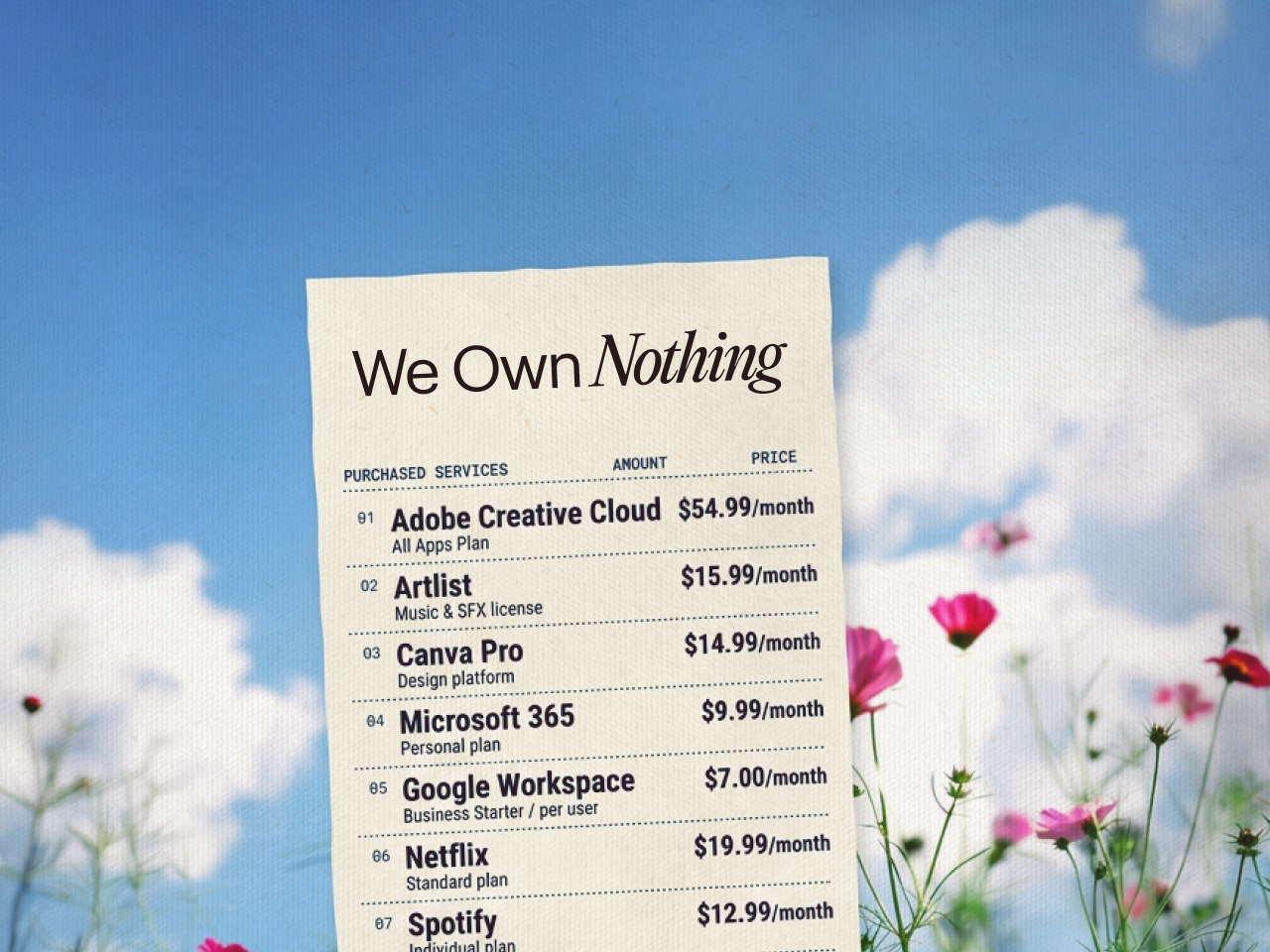
We Own Nothing
April 22, 2026
You are one missed payment away from losing everything you depend on.
In 2013, Adobe stopped selling Photoshop. Not the software itself, but the idea that you could own it. Creative Suite became Creative Cloud. A one-time purchase became a monthly invoice. Stop paying, the tools stop working. Your files stayed. Your ability to open them, less so.
The creative community was furious. Forums filled with protest threads. Petitions circulated. Design Twitter (yes, I still call it that) treated it like a civic emergency. Adobe's stock climbed regardless. Within a few years most major software companies had followed the same playbook, and the protests had gone quiet, because what else were you going to do.
Outrage has a short half-life when the alternative is no tools at all.
The subscription economy is now so ambient that we have mostly stopped noticing it. Spotify (Apple music for me, I might be showing my age here…keep reading) for music you cannot download. Netflix for films you do not own a frame of. Cloud storage for photos that disappear if you forget to renew. And then there is hardware. BMW introduced a subscription for heated seats already physically installed in the car you paid for. The hardware was there. The software gate was the product.
None of this happened by accident. Recurring revenue is worth more to investors than one-time sales. Subscriptions smooth cash flow, reduce piracy, and lock users in tightly enough that most just stay. Adobe's annual recurring revenue grew substantially after the Creative Cloud transition. It is a good model. For Adobe.
We’ve traded ownership for convenience, and the receipt arrives every month.
For creatives and creative business owners, the vulnerability here runs deeper than the bill. Your tools, your assets, your fonts, your plugins, your portfolio platform, and collaboration software: most of them now exist on a conditional basis. The condition is continued payment, continued access, and the continued goodwill of a platform that could pivot, fold, or get bought tomorrow. Figma's near-acquisition by Adobe in 2022 was a useful reminder that the services you depend on are also assets others might want.
Access and ownership are not the same thing. If you are building your practice on rented infrastructure, you are building on someone else's land. Most of the time, that is fine. The problem is that you will not find out it is not fine until the terms change.
Which subscriptions can you not survive losing? Most creatives have never sat down to answer that.
What do you actually own outright: the fonts, the files, the intellectual property? What would still function if three of your tools went dark tonight? This is not an argument against subscriptions. It is an argument for knowing where you stand before you need to know.
Ownership was always about more than control. It was about not asking anyone's permission to keep going.
Peace!

