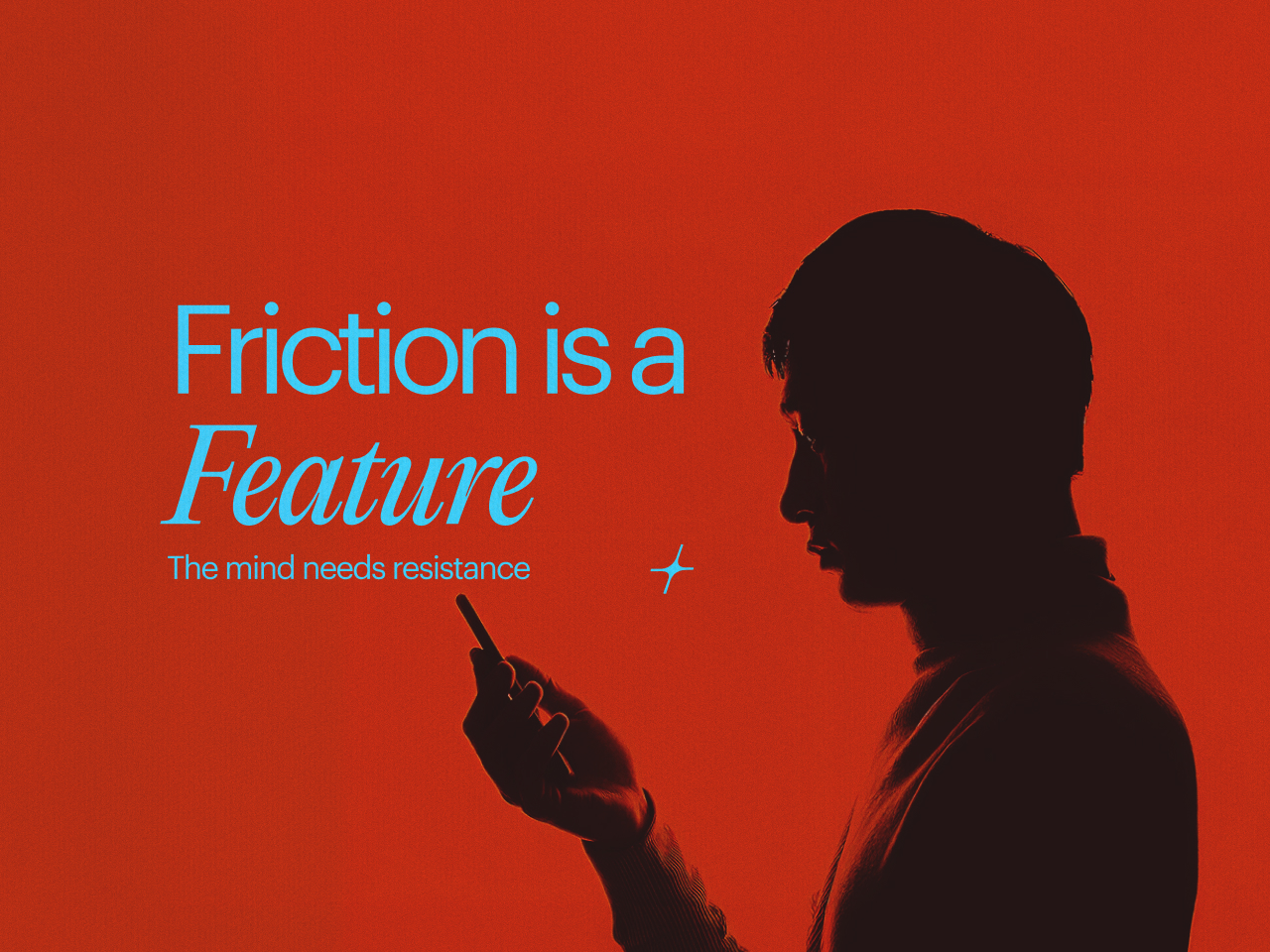
Friction is a feature
March 25, 2026
Design and tech industries have treated friction as a villain for the past decade. It shows up in user research as a problem to eliminate. Appears in countless product reviews as a complaint. Entire careers have been built around hunting it down.
We’ve all gotten good at killing it. Swipe to pay. Autoplay the next episode. Infinite scroll, so the feed never ends, and you never have to decide to keep going. The design philosophy of the 2010s was one long campaign against anything that made you wait, think, or try. And by most metrics, it worked. The internet got faster, smoother, and stickier than anyone in 1999 would have believed possible.
So what did we actually lose?
A completely frictionless experience produces consumption without commitment.
Scrolling without stopping, reacting without reflecting. You have felt it: an hour on a platform built for maximum pleasantness, and you arrive on the other side with nothing. No idea what stuck or which image stayed with you. Just a kind of pleasant numbness and the faint awareness that time went somewhere while you were not paying attention.
The design industry spent years building that experience, only to start wondering why people do not remember brands or feel loyal to products. The answer was in the design the whole time.
When nothing resists you, nothing matters to you.
This is not a theory because behavioral economists, including a well-documented Harvard Business School research thread, have consistently shown that people assign greater value to things they have struggled to make or obtain. The IKEA effect is not a quirk, but the mechanism. You love the bookshelf partly because of the three hours on the floor with that infuriating hex key. The struggle is not the price you pay for the reward, but it is often the reward.
The same logic has moved quietly into creative work itself. Look at how we talk about tools that make creative work easier. AI removes the gap between idea and execution. Templates eliminate the blank page. Optimization tools score your work before it reaches an audience. Each of these is useful. Together, they are building a creative practice with very little resistance, and that is worth sitting with.
The blank page was not just an obstacle. It was where your thinking happened.
The struggle with a brief you cannot crack is not only frustrating. It is the process by which you actually understand the problem. That presentation you prepared until you could feel every weak argument and every place the story does not hold: that repetition is not just practice. It is where the idea gets real. Take away the friction, and you often take the depth with it.
Cal Newport’s Slow Productivity framework, which has been resonating with many creative professionals in 2026, makes this case plain. Original work cannot be rushed. It requires sustained attention and time at a natural pace. The always-on, frictionless productivity mode is not simply exhausting. It actively eats the conditions that produce original thinking. You can have speed or depth. Getting both requires you to be honest about which one you are actually choosing.
Everyone is noticing this, too. This year, researchers and investors have begun documenting what is being called the IRL economy, a measurable swing back toward experiences that are effortful, in-person, and slow. Venture capital investment in real-world consumer experiences rose 25% between 2023 and the end of 2024.
Zine culture and Substack aesthetics, both deliberate, labor-intensive modes of expression, surged 85% year-over-year on design platforms.
Canva tracked a spike in lo-fi and analog styles across every creative category in its community of 260 million users.
People are not doing this because they hate convenience. They are doing it because easy is not the same as meaningful, and at some level, everyone can feel the difference.
There is a version of creative leadership entirely about optimization. Shortest path from brief to deliverable. Every source of slowness removed. Consistent, competent output with as little struggle as possible. The tools available right now are extraordinary for that. You can run a productive operation that delivers reliably and feels, from the inside, like it is working perfectly.
A few years in, you might look at the work and wonder why it does not have a soul.
The question worth asking is not: how do I make my creative process faster?
It is: which parts of my process are worth protecting from efficiency?
Not all of them. Some friction is just friction. But some of it is the thinking. Some of it is what makes the work specifically yours, rather than something that could have come from anyone or anything, at any time, for any client.
In a world where fast and technically good are all available on a subscription, being willing to go slowly starts to look less like a limitation and more like a position.
Peace.