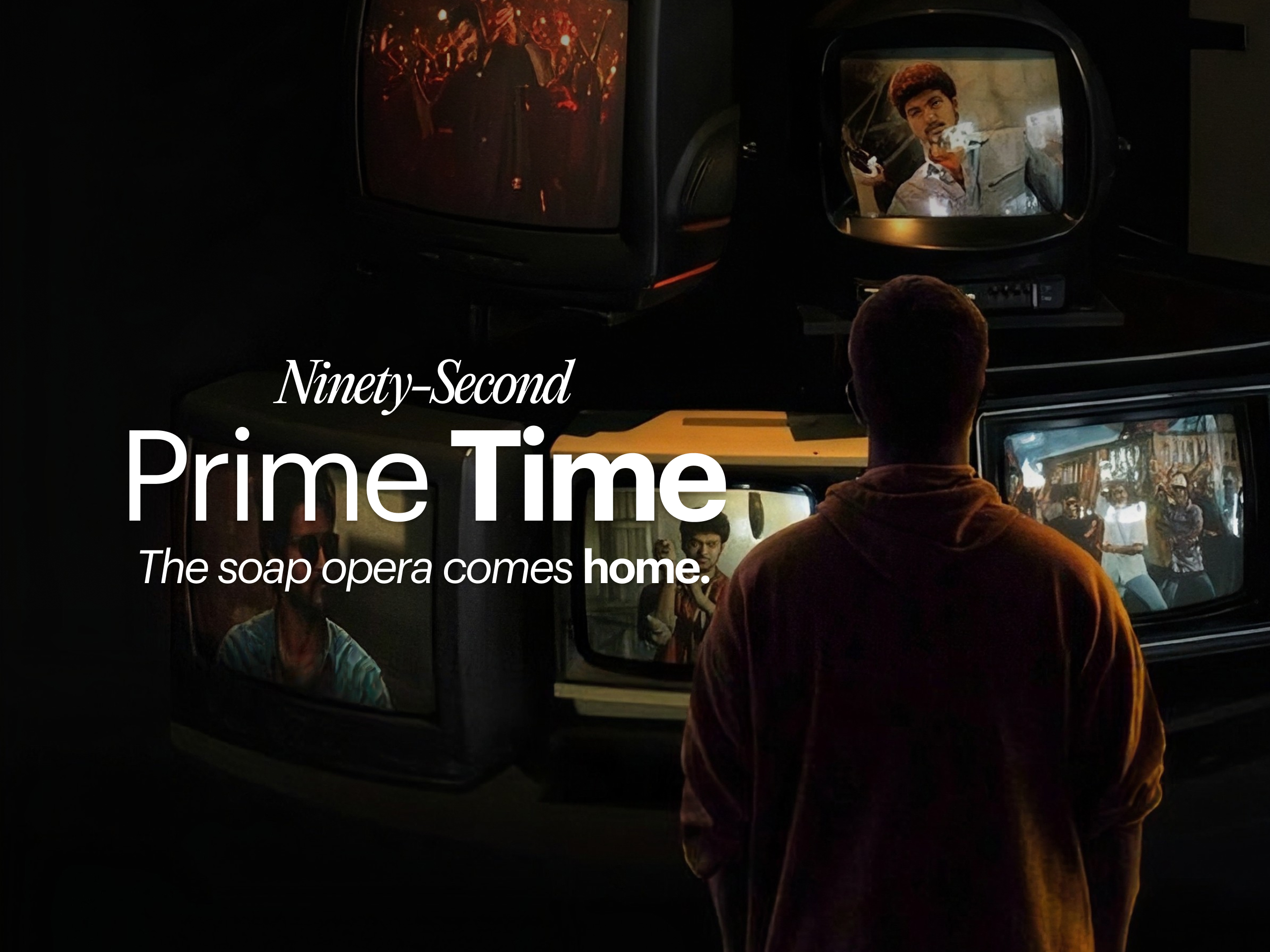
Ninety Second Prime Time

October 28, 2026
On August 14, 1933, a radio station in Cincinnati aired the first episode of a daily serial called Ma Perkins. Its sponsor was Oxydol, a laundry detergent made by Procter & Gamble. The show ran for 27 years and 7,065 episodes, and the genre it belonged to took its name from the people paying for it. Soap opera.
Last December, Procter & Gamble announced another one. The Golden Pear Affair, made for P&G's Native deodorant brand, runs to 50 episodes, shot vertically for phones, and was billed as America's first brand co-produced "microsoap." Ninety-two years after Oxydol, the company that bankrolled the soap opera is back in the soap opera business, this time in one-minute installments you watch lying down.
Every new format turns out to be an old one on a different screen.
Microdramas, if you've missed them, are scripted serials told in vertical episodes of a minute or two, each ending on a hook built to make you tap for the next. They started as a Chinese app phenomenon, and the money has followed them out. Omdia put global microdrama revenue at $11 billion in 2025, with $14 billion projected for this year.
The attention numbers are stranger still. In Omdia's analysis of Sensor Tower data, ReelShort users spend 35.7 minutes a day in the app, against 24.8 minutes for Netflix.
Before anyone redraws a media plan on the back of that, the reach is small by comparison. Similarweb counts roughly 12 million US monthly active mobile users for Netflix and 1.2 million for ReelShort. Microdramas win on depth and lose on breadth, for now.
The format crossed into the conversation creatives actually have in April, when Issa Rae released Screen Time on TikTok and PineDrama, TikTok's microdrama hub. A double-date movie night goes wrong when a mysterious figure takes over the TV and forces the couples to confess their secrets.
Twenty-seven episodes of about a minute each pulled in nearly 75 million views in the first week, according to TheWrap. One viewer's comment, quoted by the outlet, summed up the appeal:
"No ads, short, suspenseful, not AI."
Hold onto those last two words. We'll need them, because the audience is shifting, too. Holywater Tech, which runs the My Drama app, published a State of Microdrama report with Owl & Co in July. The share of male monthly users on My Drama went from 1.1 percent to 30.3 percent in seven quarters, and 70 percent of surveyed users said they watch in bed before sleep. That's a platform grading its own homework, so read it as a direction rather than a census. The direction still matters, because the slot before sleep used to belong to television.
This is why we think creatives should care beyond the money. A microdrama is the most compressed narrative format in mainstream use, and compression is a craft. Back in June we wrote about Brian Eno making 84 versions of a sound that had to fit inside three and a quarter seconds.
The best microdrama writers are working the same problem with a story. Every sixty seconds has to move something and end on a question, and then it has to do that again fifty times without the audience spotting the machinery.
The cliffhanger is now a unit of design, as real as the grid or the frame.
Most of our industry has never been asked to practice it. Advertising trained creatives to land one idea in thirty seconds and get out. A serial asks for the opposite, which is earning the next minute, then the one after that, from an audience that can swipe away at any point and owes you nothing.
That's also where brands get into trouble. Pixie USA founder Jonas Barnes, whose company produced the Native series, called microdramas "the natural evolution of the soap opera," and the history backs him up. But Ma Perkins didn't last 27 years because of the Oxydol mentions. People wanted to know what happened to Ma.
EMARKETER's guidance to advertisers lands in the same place, putting integration into the plot ahead of interruption. Nobody has published results for a brand series yet, P&G included, so everything here is still an open test.
We'd be doing you a disservice if we stopped at the exciting part. The economics are shaky. EMARKETER, citing Variety, reports that some platforms send up to 90 percent of their budgets to marketing, a growth model that tends to stall the moment paid acquisition gets expensive. And the standardized measurement advertisers rely on everywhere else doesn't exist here yet.
Then there are those two words. Holywater also runs My Muse, an app of AI-generated vertical stories, and 89 percent of users surveyed for its report said they want more AI-generated stories. Co-CEO Anatolii Kasianov called AI "the engine of that growth."
So the same format is producing a 75-million-view hit that fans praise for being made by people, and an app whose users are asking for more of what the machine writes. Both things can be true at once. Cheap, high-volume formats have always attracted the cheapest possible production, and we've written enough in these Dings about what happens to anything optimized purely for the next tap.
Our read is that this is an opening for people, and for emerging creatives in particular. The barrier to making a vertical serial is a phone, a few actors and a script that knows where to cut.
The barrier to making a good one hasn't moved at all. It's still characters someone wants to come back for.
If you write, study the radio serials, the telenovelas, the daytime soaps and the newspaper comic strips that ended every day on a hook. If you design, think about what a brand looks like across fifty one-minute appearances instead of a single thirty-second one. If you run a studio, the question to put to your next client is whether they have a story worth an episode two. Most don't, and telling them so is a service.
Ma Perkins ran for 7,065 episodes because somebody kept writing a reason to tune in tomorrow. Phones turned the screen on its side, and that job is exactly where it was.