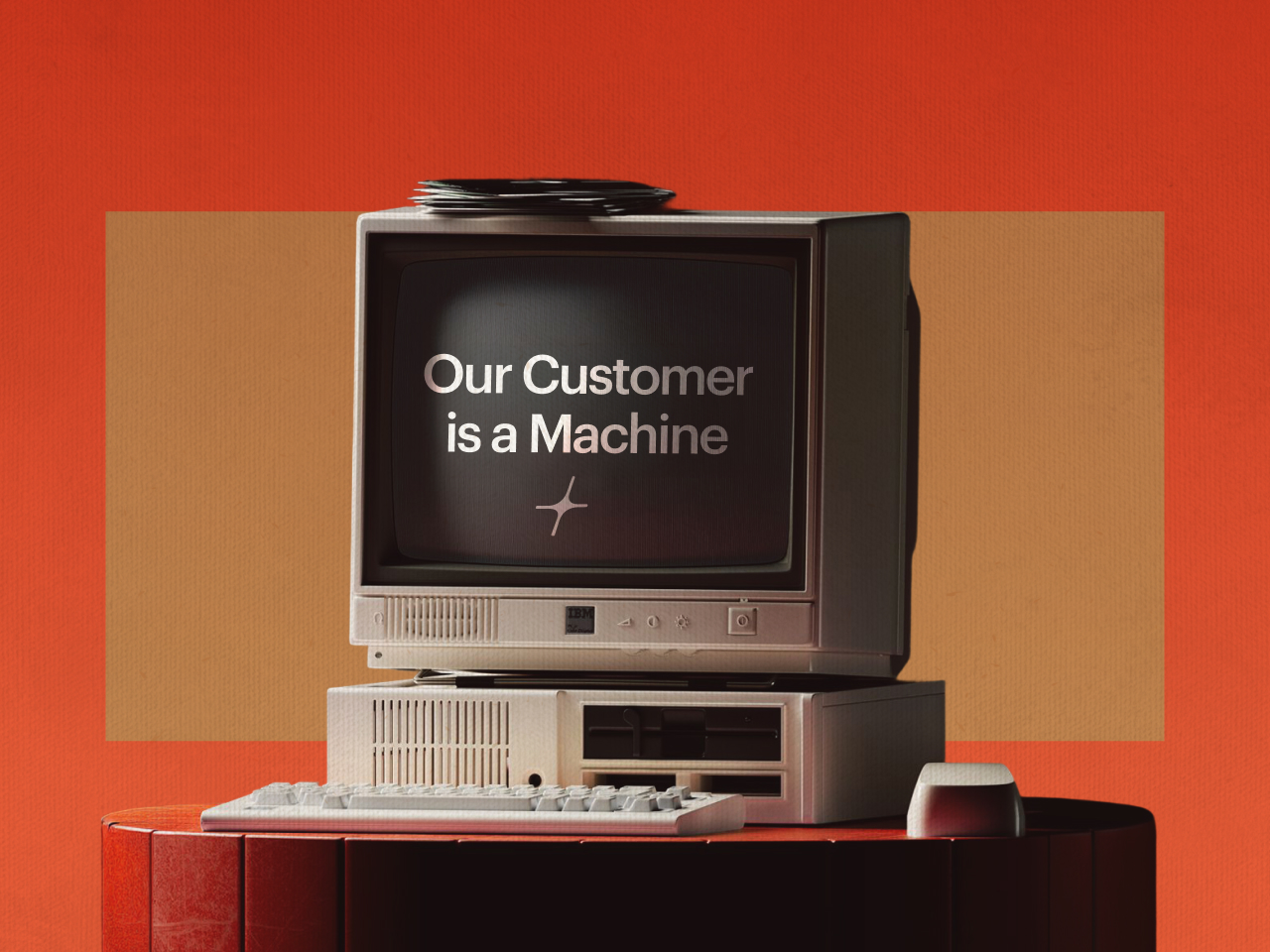
Our Customer is a Machine

May 27, 2026
Picture the most ordinary purchase in your life. Dish soap, printer ink, the running shoes you have bought four times. Now, picture that you never see it happen. You told an assistant months ago what you like and what you will not tolerate, and somewhere in the background, a piece of software compares the options, weighs the reviews, checks delivery windows, and buys the thing. No tabs or browsing. No moment where a beautiful product page makes you pause.
Is that our future? In 2026, around 73 percent of consumers report leaning on an AI agent at some point in the buying process, and AI-influenced purchases drove roughly 67 billion dollars during a single Cyber Week. OpenAI lets people buy inside ChatGPT. Shopify has built storefronts designed for agents to transact directly. The middle of the funnel, the part where we used to do all our persuading, is being handed to a machine that does not have a pulse.
Think of what that does to our entire profession. For the whole history of advertising and design, we have built for one audience: a human being who feels things. The hero image exists to trigger an emotional response. The copy is tuned to flatter, reassure, or seduce. The price ends in 99 because of a quirk in how the human brain reads numbers.
Every product page ever made assumes a person is on the other side of the glass, browsing, comparing, wanting, and deciding with a heart as much as a head.
An agent has no heart to aim at. It cannot be charmed by a font. It does not feel the warmth of your brand story or the pull of your founder's origin tale. When a person sees a higher price, good branding can make the premium feel earned. An agent confronted with the same price wants a reason it can measure: it lasts longer, it fails less, it ships faster, the reviews are better, and there are more of them. The job shifts from persuasion to completeness of information. The brand that wins the agent's recommendation is often the one whose product data is the most thorough and the most honest, not the one with the most stirring campaign.
This should rattle anyone who has spent a career learning to make people feel something. If half your buyers are now bots that cannot feel, is the emotional craft we have spent decades perfecting suddenly worth nothing?
I do not think so, and the reason is in the data itself. People are happy to delegate the boring, low-stakes, repeat purchases to an agent. They are not delegating the decisions that touch who they are. Anything tied to identity, health, money, or status, a person still wants to make with their own hands and their own gut.
Nobody is letting an algorithm choose their wedding photographer, their therapist (I hope), or the jacket they want to feel like themselves in. Emotional design does not die in the age of agents, but concentrates. It drains out of the commodity aisle, where it never really belonged, and pools exactly where feeling actually drives the choice.
So the work splits into two halves, and both need real craft.
One half is unglamorous and newly essential: making sure a brand is legible to machines at all. Clean, complete, accurate data. Structured information that an agent can parse. Showing up when an assistant goes looking, because if the agent cannot find you, you are not in the running, no matter how lovely your homepage is. The metric that mattered for years, the click, starts giving way to whether an agent retrieves and recommends you in the first place.
The other half is the part that should excite anyone who got into this for the human reasons. As routine buying disappears into the background, the moments that remain visible to people become more loaded, not less. A person who outsources the dish soap has freed up all their attention for the choices they care about, and those choices are where taste, story, and feeling decide everything. There is also a new surface to design that did not exist before: the relationship between a person and the agent buying on their behalf.
How a brand earns enough trust to be the default an assistant reaches for. How does it stays present in a life where the customer has stopped looking directly at it? That is a genuinely new design problem, and we are early enough that no one has solved it well.
The uncomfortable framing, and the useful one, is that the agent is a brutally honest critic (not for all, though).
It cannot be fooled by polish over substance, because it does not register polish. If your advantage was real, the agent would find it in the data and reward it. If your advantage was mostly vibes layered over a mediocre product, the machine strips the vibes away, leaving you exposed. That is terrifying for brands built solely on persuasion. For anyone whose work is actually good, it is the fairest judge they have ever faced.
The buyer who feels nothing is already in the room. The question for the rest of us is whether we know which of our customers still has a heartbeat, and whether we are doing our best work for them.