
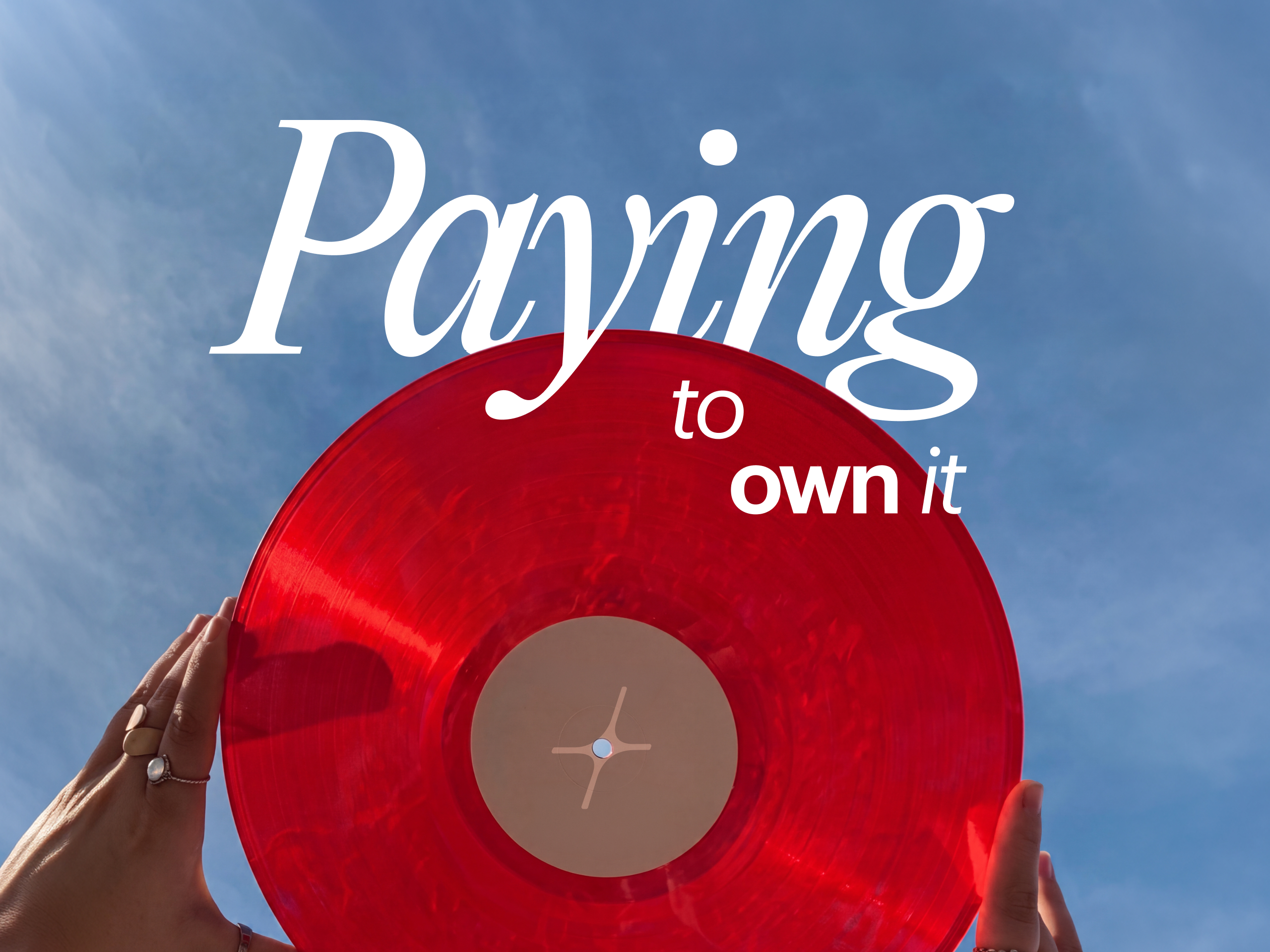
Paying to own it

September 9, 2026
The last time vinyl revenue in the Unite States crossed a billion dollars, was 1983.
Thriller was the album everyone owned, the compact disc had just gone on sale, and the industry was about to spend two decades explaining that physical records were finished (can you even imagine that?).
In 2025, vinyl crossed a billion again. The RIAA's year-end report, released in March, put it at $ 1.04 billion, up 9.3%, on 46.8 million units. Nineteenth consecutive year of growth, and that’s mind-blowing.
Luminate's numbers tell you which way the wind is blowing inside the format. US physical album sales rose 6.5% last year while digital album sales fell 15.9%.
People are buying less files, but buying more objects (of affection).
And they are paying more for them. According to Discogs data reported by The Hollywood Reporter, the average price of a mint-condition record rose from roughly $30 to $37.22 between 2020 and 2025, a 24% increase. Prices up, volume up, in a market where the exact same music is available for the cost of a couple of sandwiches a month.
There were 106.5 million paid streaming accounts in the US last year. A meaningful number of those subscribers went out and bought a record anyway.
We do not think this is nostalgia. Nostalgia is what people say when they cannot be bothered to look at the receipts. Half the top-selling vinyl in any given year is current pop, bought by people who were not alive for the format's first run. This is about ownership, and it is worth thinking about because it points in the exact opposite direction from where our own industry has gone.
In April, we wrote about how creatives now rent everything in our we own nothing piece. The software, fonts, storage, portfolio platform, all of it conditional on a monthly payment and the continued goodwill of a company that could be acquired next quarter. That piece was about the vulnerability of building a practice on land you do not own.
Our audience went the other way. Given a choice between infinite access and one thing they can hold, a growing number are paying a premium for the thing they can hold. They understood the trade before we did.
The commercial detail that should interest anyone who designs for a living is what is driving the growth. Alliance Entertainment, which moved 16.3 million records in the year to December 2025, attributed its increase to demand for collectible and limited-edition releases. Around 40% of vinyl sales go through independent retailers rather than big-box stores. The purchase is not the audio. The audio is free and always will be.
The purchase is the sleeve, the color of the wax, the insert, the exclusive that only exists at one shop, the weight of the thing in your hands on the walk home.
Which means the packaging is not the packaging, but the product. That is a full inversion of how most of our profession has been taught to think about physical output, where the object is the afterthought at the end of the identity system, budgeted last and designed by whoever had a free Thursday.
We should be careful not to oversell any of this. Vinyl is still a small slice of the business, under 10% of US recorded music revenue, compared with $9.47 billion from streaming. Two albums moving more than five million units apiece last year, from Taylor Swift and Morgan Wallen, distort the picture considerably. And the variant economy has real costs, from pressing plant capacity to the fact that a 24% price rise in five years slowly prices out the young collectors the industry keeps congratulating itself for attracting. A format can grow and be getting worse for the people who love it at the same time.
The transferable idea survives all of those caveats.
When something becomes infinitely available, the version of it you can own becomes worth paying for.
That has held for music, and we would bet on it holding for anything else that gets flattened into a feed.
So the question we have started asking ourselves at a small studio (publishers of Ding!), and the one we would put to you.
If everything you made this year exists only as a file that a platform can revoke, update, or deprecate, then you have built something rentable, and rentable things are priced accordingly.
What is the version of your work that somebody would pay to hold?
For some of you that is a printed piece, a small run, a book nobody commissioned. For others it is the part of a brand system that exists in the physical world at all. Look at the last identity you shipped and count the touchpoints. If there are forty digital ones and zero you could pick up, you have designed something with no weight, and weight is what people are currently paying for.
The generation everyone insists on calling digital natives just spent more than a billion dollars on a format introduced in 1948.
