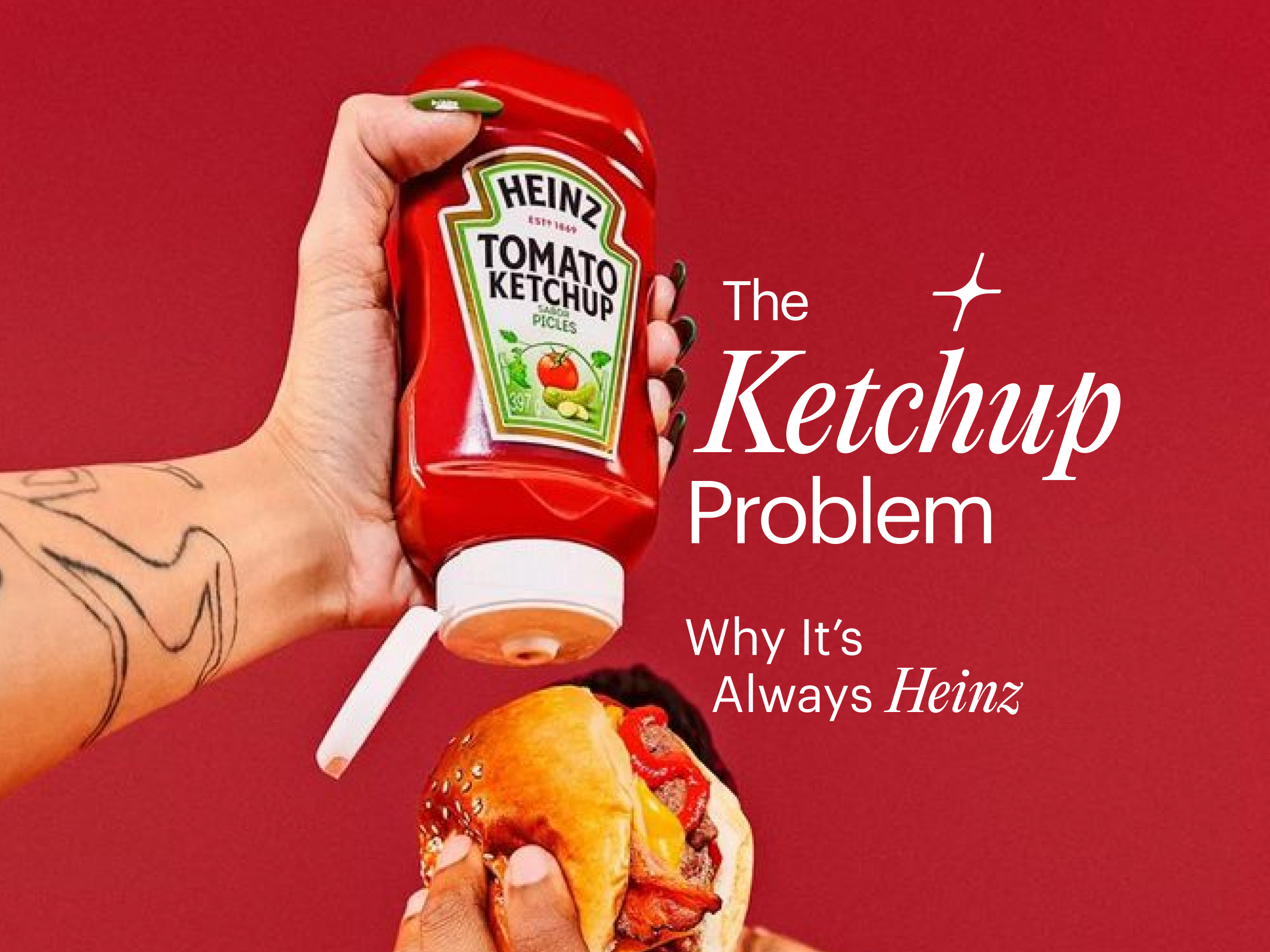
The Ketchup Problem

August 26, 2026
A team sat down and typed the word "ketchup" into an AI model. Then did it again. And again.
Heinz came back almost every time.
That test formed a campaign and can also be found a few pages into the AI & Creativity Report 2026: The Cost of the Shortcut, published on August 18. The report rests on 197 conversations with creative leaders across 30 countries, roughly 82 hours of interviews, plus an analysis of more than 10,000 D&AD Award entries. There is a lot in there worth arguing with. The ketchup line is the one we cannot seem to break free from. The report explains it in eight words:
"Forty years of distinctive brand-building set the default."
Consider what that actually means commercially. The model was not recommending anything. It has no opinion about tomatoes, thank goodness. But it was reporting a consensus that already existed in the world, then handing that consensus to whoever asked. Heinz spent four decades making itself the picture that appears when a person imagines the category, and that work is now inside a system that answers millions of questions a day, at no cost to Heinz, with no media plan attached.
Throughout the history of our profession, brand equity has paid out through human memory.
You built recognition so that a shopper standing in an aisle, tired, holding a basket, reached for the familiar thing. That payout still exists, but a second one has been added for machine retrieval, and it accrues to whoever was already famous for being specific.
Before anyone turns this into a strategy deck (we know how it gets), some honesty about the limits. Being the default answer is not the same as being bought. Nobody has yet shown that model defaults move market share in any measurable way, and the default itself is unstable, since models retrain, retrieval layers pull live data from the web, and today's answer is not guaranteed to survive the next release. Treat the ketchup finding as a signal about how these systems behave, not as a law of physics.
The direction still matters because more of the buying journey is passing through software with no eyes on it. We wrote about that in May, in the our customer-is-a-machine piece, when we looked at what happens to persuasion once your customer is an agent with no capacity to feel charmed. The ketchup test is the other half of that story. It is not about the moment of purchase, but about who gets considered at all.
The part that should worry the people paying agencies is buried in VML's Future 100 for 2026, built on a survey of 15,639 adults across 16 markets, found that 76 percent of respondents agreed few brands stand out as distinctive.
Three-quarters of the market looks at the whole category and sees beige.
Most brands were already invisible to human beings. The model has just made that invisibility legible, and it will keep making it legible every time someone asks a generic question.
There is a second cost the report tracks, and we have written about it before too, so we will not relitigate it here. The tasks being handed to machines are the same tasks that used to build judgment in a young creative. The IPA's Agency Census found that the proportion of employees aged 25 and under at UK member agencies fell by 19.2 percent year on year, now at 11.8 percent of the sector, down from 17.4 percent three years ago. In the US, the share of advertising and PR jobs held by 20-to 24-year-olds dropped from 10.5 percent in 2019 to 6.5 percent in 2024. To D&AD's credit, they do not pin all of that on AI, and note that only 8 percent of UK agencies blame it directly for headcount cuts. Consolidation and cost pressure are doing plenty of work. Unfortunately, the outcomes are the same either way.
So what encodes and comes up for people? Whatever is specific enough to be described in words, because text is what these systems consume. A shape that can be named. A color with an owner. A phrase nobody else can legally or comfortably say. A brand whose distinctiveness lives entirely in a gradient and a tasteful sans has left nothing behind to retrieve, and it will be as absent from the model as it already is from the customer's memory.
We want to be careful here because there is an obvious wrong turn. If the industry starts optimizing identities for machine retrieval, we will produce a generation of brands that parse beautifully and mean nothing, which is exactly how the internet ended up drowning in writing shaped for search engines rather than readers.
The perspective is not to design for the model, but to be specific enough that a person and a machine can both find you, which is what we were supposed to be doing anyway.
The question worth taking into your next brand conversation is uncomfortable in a useful way.
If somebody typed your client's category into a model tomorrow, would their name come back?
And if the answer is no, what would they have needed to do differently, starting roughly fifteen years ago?
Usually the answer is: the same thing, for longer, without abandoning it every time a new creative director walked in with a mood board (ouch).